SNVSC83C September 2022 – October 2025 TPSM365R3 , TPSM365R6
PRODUCTION DATA
- 1
- 1 Features
- 2 Applications
- 3 Description
- 4 Device Comparison Table
- 5 Pin Configuration and Functions
-
6 Specifications
- 6.1 Absolute Maximum Ratings
- 6.2 ESD Ratings
- 6.3 Recommended Operating Conditions
- 6.4 Thermal Information
- 6.5 Electrical Characteristics
- 6.6 System Characteristics
- 6.7 Typical Characteristics
- 6.8 Typical Characteristics: VIN = 12 V
- 6.9 Typical Characteristics: VIN = 24 V
- 6.10 Typical Characteristics: VIN = 48 V
-
7 Detailed Description
- 7.1 Overview
- 7.2 Functional Block Diagram
- 7.3
Feature Description
- 7.3.1 Input Voltage Range
- 7.3.2 Output Voltage Selection
- 7.3.3 Input Capacitors
- 7.3.4 Output Capacitors
- 7.3.5 Enable, Start-Up, and Shutdown
- 7.3.6 External CLK SYNC (with MODE/SYNC)
- 7.3.7 Switching Frequency (RT)
- 7.3.8 Power-Good Output Operation
- 7.3.9 Internal LDO, VCC UVLO, and BIAS Input
- 7.3.10 Bootstrap Voltage and VBOOT-UVLO (BOOT Terminal)
- 7.3.11 Spread Spectrum
- 7.3.12 Soft Start and Recovery from Dropout
- 7.3.13 Overcurrent Protection (OCP)
- 7.3.14 Thermal Shutdown
- 7.4 Device Functional Modes
-
8 Application and Implementation
- 8.1 Application Information
- 8.2
Typical Application
- 8.2.1
600-mA and 300-mA Synchronous Buck Regulator for
Industrial Applications
- 8.2.1.1 Design Requirements
- 8.2.1.2
Detailed Design Procedure
- 8.2.1.2.1 Custom Design With WEBENCH® Tools
- 8.2.1.2.2 Output Voltage Setpoint
- 8.2.1.2.3 Switching Frequency Selection
- 8.2.1.2.4 Input Capacitor Selection
- 8.2.1.2.5 Output Capacitor Selection
- 8.2.1.2.6 VCC
- 8.2.1.2.7 CFF Selection
- 8.2.1.2.8 Power-Good Signal
- 8.2.1.2.9 Maximum Ambient Temperature
- 8.2.1.2.10 Other Connections
- 8.2.1.3 Application Curves
- 8.2.1
600-mA and 300-mA Synchronous Buck Regulator for
Industrial Applications
- 8.3 Power Supply Recommendations
- 8.4 Layout
- 9 Device and Documentation Support
- 10Revision History
- 11Mechanical, Packaging, and Orderable Information
Package Options
Mechanical Data (Package|Pins)
- RDN|11
Thermal pad, mechanical data (Package|Pins)
- RDN|11
Orderable Information
3 Description
The TPSM365R6 or TPSM365R3 is a 600mA or 300mA, 65V input synchronous step-down DC/DC power module that combines power MOSFETs, integrated inductor and boot capacitor in a compact and easy-to-use 3.5mm × 4.5mm × 2mm, 11-pin QFN package. The small HotRod™ QFN package technology enhances the thermal performance and low EMI. The device features the ultra-low operating IQ of 4μA at no load (24V to 3.3V VOUT). The TPSM365Rx is available in two fixed output voltage option supporting 3.3V and 5V, and an adjustable output voltage option supporting 1V to 13V range. The module only requires four external components for a 3.3V and 5V fixed output design The TPSM365Rx is optimized for excellent EMI performance and space constraint applications.
| PART NUMBER(3) | PACKAGE(1) | PACKAGE SIZE(2) |
|---|---|---|
| TPSM365R6 | RDN (QFN-FCMOD,11) | 4.50mm × 3.50mm |
| TPSM365R3 |
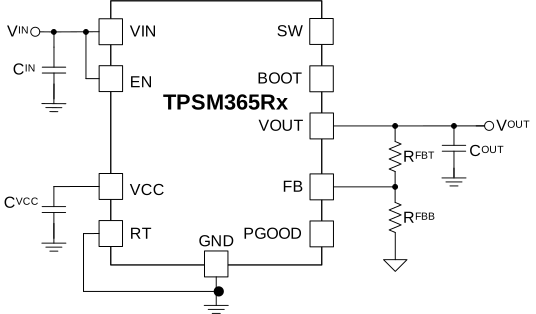 Typical Schematic
 Efficiency vs Output Current VOUT =
5V, FSW = 1MHz
Efficiency vs Output Current VOUT =
5V, FSW = 1MHzThe TPSM365Rx uses a peak
current mode control scheme with internal compensation to maintain stable operation
with minimal output capacitance. The precision EN feature allows precise control of
the device during start-up and shutdown. An open-drain PGOOD output provides a true
indication of the output voltage status. The TPSM365Rx includes prebias start up,
overcurrent, and temperature protections, making the TPSM365Rx an excellent device for powering a wide range of industrial
applications. In the fixed option variants,
the MODE/SYNC pin enables seamless transition from FPWM to PFM with a no-load
standby quiescent current of less than
4μA, making
sure of high efficiency and excellent transient response for the entire
load-current range.