SPRAD03 March 2022 AM2431 , AM2431 , AM2432 , AM2432 , AM2434 , AM2434 , AM6411 , AM6411 , AM6412 , AM6412 , AM6421 , AM6421 , AM6422 , AM6422 , AM6441 , AM6441 , AM6442 , AM6442
- Trademarks
- 1 System Overview
- 2 Hardware Prerequisites
- 3 Hardware Configuration
- 4 HW Pinouts, Default Jumpers, and Connections
- 5 Schematics
- 6 Jumper Settings and Descriptions
- 7 LEDs
- 8 Software Architecture
- 9 Actuation and Feedback Timing
- 10Benchmark Results
-
11Detailed Demo User's Guide
- 11.1 Step 0. Getting the Software and Building
- 11.2 Step 1. Getting Started With the Hardware
- 11.3 Step 2. Configure ROQ437 EnDat2.2 Encoder for Faster EnDat 2.2 Recovery Time (only needs to be done once the first time you use the ROQ437 encoder)
- 11.4 Step 3. Open Loop Iq Control (BUILDLEVEL == OPEN_LOOP_IQ_ID)
- 11.5 Step 4. Closed Loop Iq/Id Control (BUILDLEVEL == CLOSED_LOOP_IQ_ID)
- 11.6 Step 5. Closed Loop Speed Control (BUILDLEVEL == CLOSED_LOOP_SPEED)
- 11.7 Step 6. Closed Loop Position Control (BUILDLEVEL == CLOSED_LOOP_POSITION)
- 12Build Using MCU+SDK 08.00.00.21 & CCS 10.3.1
- 13Summary
- 14Appendix A: Detailed Motor Control R5F Processing Time
- 15References
11.3 Step 2. Configure ROQ437 EnDat2.2 Encoder for Faster EnDat 2.2 Recovery Time (only needs to be done once the first time you use the ROQ437 encoder)
The ROQ437 defaults to a slower EnDat2.1 recovery time between position latches. EnDat2.2 enables a faster recovery time but we need to set a non-volatile bit one time in the ROQ437 before running the rest of the demo to reduce the recovery time. This is a workaround for now that can be incorporated into the demo code at a later time.
Explanation from the Heidenhain documentation (https://www.heidenhain.us/wp-content/uploads/Bidirectional_Interface_for_Position_Encoders-1.pdf): The extended EnDat interface version 2.2 is compatible in its communication, command set and time conditions with the previous version 2.1, but also offers significant advantages. It makes it possible, for example, to transfer additional information with the position value without sending a separate request for it. The interface protocol was expanded and the time conditions were optimized as follows: Increased clock frequency (CLOCK) (16 MHz), Optimized calculating time (position value acquisition within 5 µs), Minimized dead time (recovery time) (1.25 µs to 3.75 µs), Expanded power supply range (3.6 V to 5.25 V or 14 V at the encoder)
- Plug in all of the hardware to connect the EnDat2.2 encoder into the slot closest to the TMDS243GPEVM
- Import into CCS the 'endat_diagnostic' example from the MCU+ SDK located at '%SDK_INSTALL_DIR%\examples\motor_control\endat_diagnostic'
- Build the example and load it into MAIN_Cortex®_R5_0_0
- Setup the terminal in Code
Composer Studio™ (CCS) to view the diagnostic output (my port is COM6
below but yours may differ):
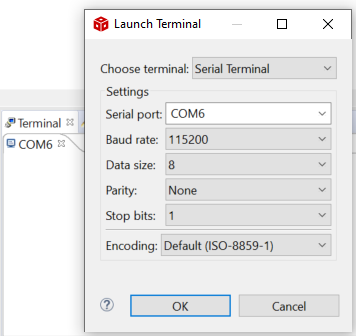 Figure 11-5 COM Port for
Diagnostic Output
Figure 11-5 COM Port for
Diagnostic Output - Click 'Resume (F8)' to run the Diagnostic
- Select 'y' for Multi channel
configuration, select 'y' for select channel 0, and select 'n' for channel 1 and
channel 2.
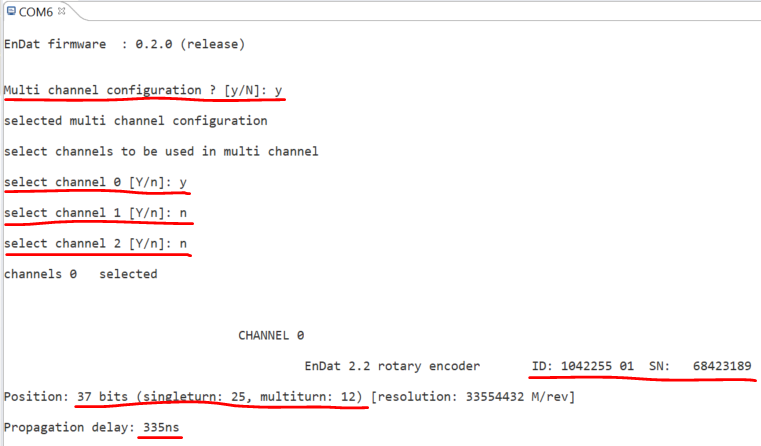 Figure 11-6 EnDat 2.2 Diagnostic
Output
Figure 11-6 EnDat 2.2 Diagnostic
Output - After these selections the diagnostics should communicate with the encoder and return ID, SN, and information about the resolution and propagation delay
- Connect a logic analyzer to to
the EnDat CLK, TX, and RX pin (these pins can be accessed on the right angle
connector of the TIDA-00179 board as shown below)
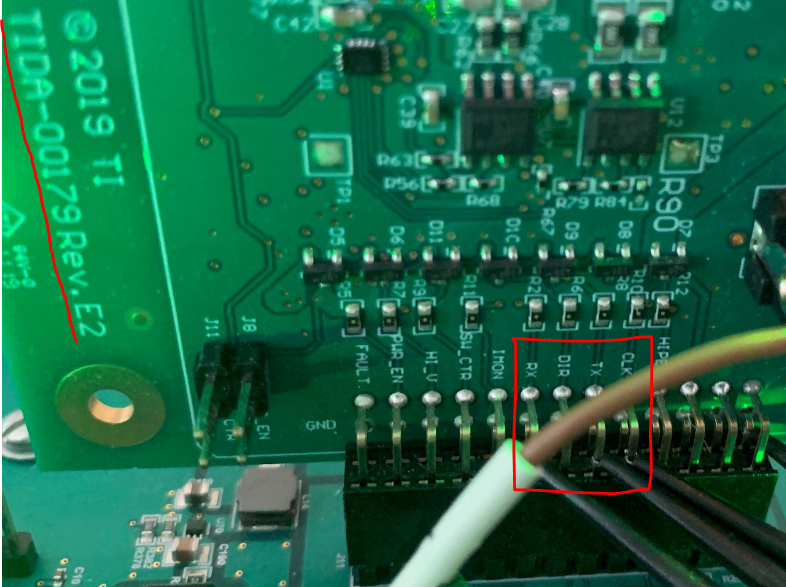 Figure 11-7 Measure EnDat CLK, TX
and RX Pins
Figure 11-7 Measure EnDat CLK, TX
and RX Pins - Select option '107' in the
diagnostic and enter '8000' for the frequency in Hz. This causes the program to
continuously request data from the encoder like that shown in Figure 11-8.
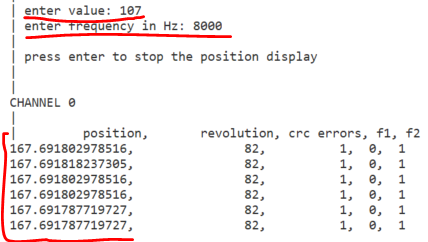 Figure 11-8 EnDat 2.2 Position
Output
Figure 11-8 EnDat 2.2 Position
Output - Run the logic analyzer while the
simulated position loop is running and look at the recovery time on the RX
signal (the time the RX signal is held high after the CLK stops):
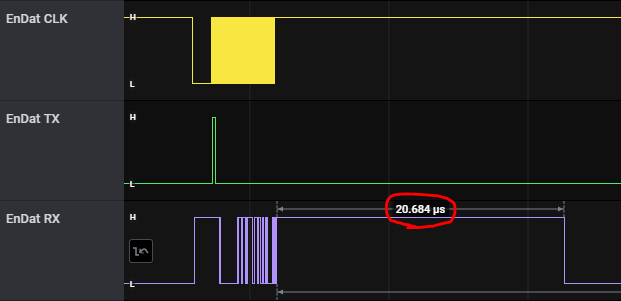 Figure 11-9 RX Signal (Before
Change)
Figure 11-9 RX Signal (Before
Change) - To set the bit to enable EnDat2.2
recovery mode select diagnostic option: 10, parameter address: 3, and parameter
value: 1
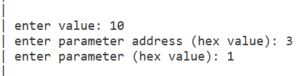 Figure 11-10 EnDat 2.2 Recovery
Mode Change
Figure 11-10 EnDat 2.2 Recovery
Mode Change - Then select diagnostic option '5' to reset the encoder in order for the setting to take effect
- Re-run option 107 with 8000 as
the frequency to ensure that the setting has been saved and that the recovery
time is less than 3.75 µs:
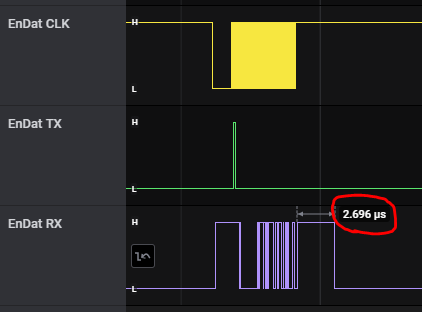 Figure 11-11 RX Signal (After
Change)
Figure 11-11 RX Signal (After
Change) - If the recovery time is still around 20 µs, you may need to try the previous steps one more time (option 10, address 3, value 1, then option 5 to reset)
At this point, your encoder should be configured to run in EnDat2.2 recovery mode, which allows for the tight timings that is needed throughout the rest of the demo.