SLAAEH1 January 2024 MSPM0C1105 , MSPM0C1106 , MSPM0G1106 , MSPM0G1107 , MSPM0G1506 , MSPM0G1507 , MSPM0G1518 , MSPM0G1519 , MSPM0G3106 , MSPM0G3106-Q1 , MSPM0G3107 , MSPM0G3107-Q1 , MSPM0G3506 , MSPM0G3506-Q1 , MSPM0G3507 , MSPM0G3507-Q1 , MSPM0G3518 , MSPM0G3518-Q1 , MSPM0G3519 , MSPM0G3519-Q1 , MSPM0H3216
Electric vehicles are becoming more and more popular. Passive Entry Passive Start (PEPS) is an automotive system that allows the user to access and start the vehicle without taking the key out of a bag or pocket. The driver can automatically lock and unlock the car doors when in proximity of the vehicle, and start or stop the engine by pushing the ignition button. To lock the vehicle, the user moves away from the car with the key, or touches a button or specific area on one of the door handles, depending on the ergonomic option selected by the manufacturer. There is some technology for a PEPS system (RFID, BLE, WIFI and UWB) and each have advantages and disadvantages. Due to the high-precision positioning characteristics of UWB, UWB is currently used in PEPS systems and is sometimes combined with BLE to build a more intelligent PEPS system.
Overall, UWB technology is useful for car owners everywhere for both increased security and added simplicity when using car keys. Now, a user can leverage a MSPM0 MCU to design a lower-cost and higher-scalability UWB PEPS system.
Why integration with MSPM0?
- High-performance core: 32 or 80MHz Cortex-M0+ Core
- Abundant communication resource: CANFD, LIN, SPI, I2C, UART.
- High scalability: meets different communication and control requirements with a flexible software system rather than a fixed discrete hardware system.
- High reliability: meets AEC-Q100 qualified options.
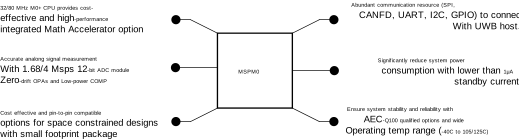 Figure 1 MSPM0 MCU Series
Overview
Figure 1 MSPM0 MCU Series
OverviewWhat can MSPM0 do in a UWB PEPS system?
- Communicates with UWB module to
receive information through SPI peripherals.
- Two SPIs support up to 32Mbit/s.
- Accurate analog resource to boost
signal measurement.
- 12-bit SAR ADC with 11.2ENOB and 1.68M and 4MSPS sampling rate.
- Two mode (low-power and high speed) comparator with 8-bit reference DAC.
- Runs control and decodes code with a MSPM0 32 or 80MHz core.
- Exchanges data with host through
UART, I2C, SPI, or GPIO.
- Four UART interfaces (3 × UART) supporting low-power operation in standby mode.
- Four I2C interfaces that support wakeup from stop mode.
- Connects to auto CAN bus through
MSPM0 CANFD peripherals (only in MSPM0G series).
- One Controller Area Network (CAN) interface supports CAN 2.0 A or B and CAN-FD.
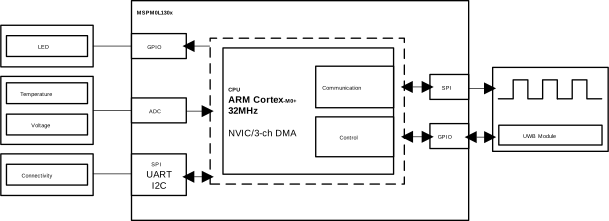 Figure 2 Block Diagram of UWB PEPS
System Based on MSPM0L130x
Figure 2 Block Diagram of UWB PEPS
System Based on MSPM0L130x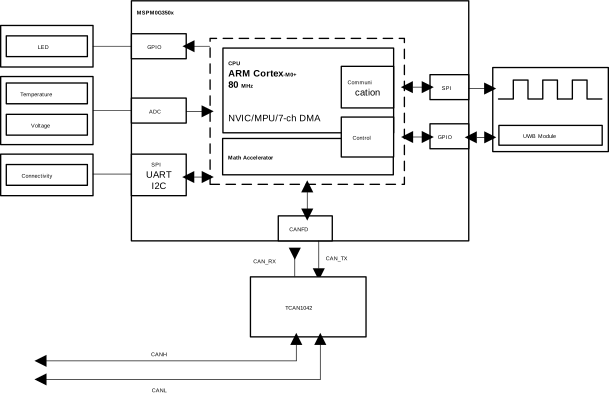 Figure 3 Block Diagram of UWB PEPS
System Based on MSPM0G350x
Figure 3 Block Diagram of UWB PEPS
System Based on MSPM0G350xResources
Order a LP-MSPM0L1306 or LP-MSPM0G3507development kit to start designing a UWB Passive Entry Passive Start (PEPS) design now. Jump-start coding with the substantial software development kit MSPM0-SDK and graphical code generation tool SysConfig. See the following list for additional MSPM0 resources.
- Texas Instruments, Arm Cortex-M0+ MCUs, product page.
- Texas Instruments, MSPM0 Academy, training resource.
- Texas Instruments, MSPM0L130x Mixed-Signal Microcontrollers, data sheet.
- Texas Instruments, MSPM0G350x Mixed-Signal Microcontrollers With CAN-FD Interface, data sheet.
- Texas Instruments, MSPM0 G-Series 80-MHz Microcontrollers, technical reference manual.
- Texas Instruments, MSPM0 L-Series 32-MHz Microcontrollers, technical reference manual.
- Texas Instruments, MSPM0 L-Series MCUs Hardware Development Guide , application note.
- Texas Instruments, MSPM0 G-Series MCUs Hardware Development Guide, application note.