SLAAEL8 May 2024 MSPM0C1104 , MSPM0C1105 , MSPM0C1106 , MSPM0G1106 , MSPM0G1107 , MSPM0G1506 , MSPM0G1507 , MSPM0G1518 , MSPM0G1519 , MSPM0G3106 , MSPM0G3106-Q1 , MSPM0G3107 , MSPM0G3107-Q1 , MSPM0G3506 , MSPM0G3506-Q1 , MSPM0G3507 , MSPM0G3507-Q1 , MSPM0G3518 , MSPM0G3518-Q1 , MSPM0G3519 , MSPM0G3519-Q1 , MSPM0H3216 , MSPM0L1306
In the automotive industry, comfort has become a paramount feature distinguishing premium vehicles. Instead of moving the seat, window, and sunroof manually with levels in the past, now the switches can be used to adjust the seat height, seat tilt, distance from the pedal, seat temperature, sunroof open or close and so on, in these designs, microcontroller and direct current (DC) motors are the main components.
Today we take the automotive seat comfort module as an example, which is a pivotal component aimed at enhancing passenger experience by offering customizable seating positions, temperature control, smart memory seating, and other features.
TI’s MSPM0 devices Arm® Cortex® based M0+ microcontrollers (MCU) include automotive-qualified (AEC-Q100) MCUs that can be used to meet the design requirement of a seat comfort module.
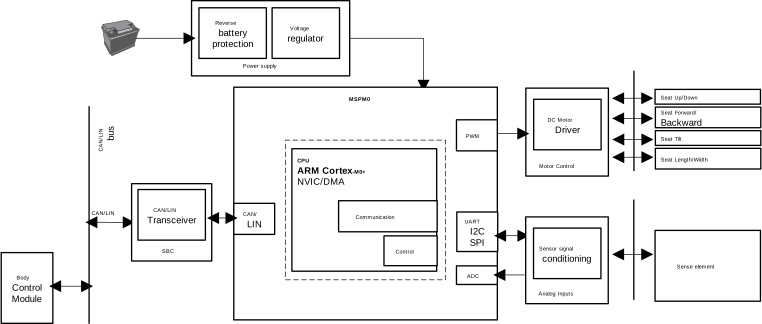
The following image shows the typical block diagram.
Benefits of Using MSPM0 Microcontrollers
- Energy Efficiency: The power consumption can be as low as 71μA/MHz in running mode and 1μA in standby mode, which provides minimal power consumption while managing multiple seat functions.
- Compact Size: Offers a wide range of packages optionally as small as 2mm × 2mm WSON8 non-leaded package, to enable integration into space-constrained automotive environments without sacrificing performance.
- Cost-Effectiveness: Offers a balance between functionality and price, making MSPM0 an excellent choice for a wide range of vehicles.
- Precision Control: Provides accurate and responsive adjustments to seat settings, enhancing the overall comfort and experience for the user.
The following are few use cases that can benefit from using MSPM0:
Use Case 1: Precision Control Over Complex Adjustments
Automotive seats today offer complex adjustments beyond simple forward and backward movements, including tilting, height adjustments, and lumbar support modifications.
- The MSPM0 integrated high-performance ADC reads the data from the sensor and converts the analog signals into digital inputs for processing.
- Based on the processed sensor data, MSPM0 sends control signals to motors and actuators responsible for adjusting seat components. The MSPM0 16-bit advanced timer allows for the fine-tuning of motor operations, facilitating the precise and incremental adjustments needed for these complex functions. This level of control is essential for achieving the exact seating positions desired by the user, enhancing the overall driving and riding experience.
Use Case 2: Smart Memory Seating
A notable application of the Arm Cortex M0+ microcontroller in automotive seat comfort modules is the smart memory seating function. This feature allows the seat to automatically adjust to pre-set positions based on the user’s preference.
- MSPM0 continuously reads data from the sensor and stores the data in non-volatile memory, which is used to save multiple user profiles and seat configurations. Each user profile includes personalized settings for seat position, lumbar support, and climate control preferences
- Based on the stored user profiles, MSPM0 sends control signals to motors and actuators responsible for seat components
Getting Started with MSPM0 Automotive MCUs
Pick a low-cost MSPM0 LaunchPad™ Development Kit today to start evaluating the device for seat comfort design. Easy to start with MSPM0 code examples and interactive online trainings are available in the MSP Academy. The relevant resources links follow: