SLAAET2A March 2025 – September 2025 TAS2120 , TAS2320 , TAS2572 , TAS2574
2 What is Y-Bridge
Y-Bridge is an amplifier architecture designed to switch between two power rails based on power demand with a programmable power threshold that optimizes efficiency at lower power levels and reduces consumption in standby or idle states. The architecture resembles a Y shape, distinguishing this from the traditional linear half-bridge design. Figure 2-1 shows the difference between a traditional Class-D amplifier vs the amplifier with Y-Bridge architecture.
For a classic half-bridge architecture, the output stage relies solely on a high-voltage supply (PVDD) for switching. In contrast, the Y-Bridge architecture utilizes both a high-voltage supply (PVDD) and a fixed low-voltage rail (VDD). At low output power levels, including idle states where minimal headroom is needed, the amplifier operates on the lower voltage rail (VDD) without causing clipping, significantly improving efficiency. When power demand rises and greater headroom is required, the amplifier seamlessly switches to the high-voltage supply (PVDD), matching the efficiency of a standard system without the Y-Bridge. This is why the benefits of the Y-Bridge can be realized the most at lower power levels, where traditional Class-D amplifiers are typically less efficient.
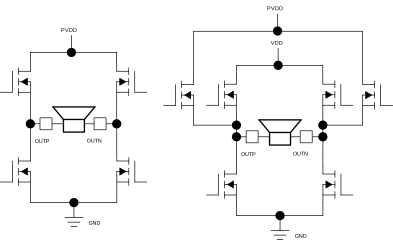 Figure 2-1 Traditional Class-D Amplifier
vs Simplified Y-Bridge Architecture
Figure 2-1 Traditional Class-D Amplifier
vs Simplified Y-Bridge ArchitectureTI’s latest audio amplifiers — including the TAS2120, TAS2320, TAS2572, and TAS2574 — feature the Y-Bridge architecture. Users can configure the device to enable or disable this functionality, but when disabled, the amplifier relies solely on the PVDD supply. In this case, this is essential to make sure the PVDD voltage is high enough to prevent clipping.