SLVAFR8 January 2025 TPS1685 , TPS1689 , TPS25984 , TPS25984B , TPS25985 , TPS25990
- 1
- Abstract
- Trademarks
- 1Introduction
- 2Over-Current Response of Conventional eFuse Devices
- 3Challenges with Current Limit Functionality
- 4Proposed Design Using TI's High-Current eFuses
- 5Thermal Performance with Continual Transient Load Current
- 6System Level Advantages with TI's eFuse Design
- 7Summary
- 8References
4.1 Steady-State Over-Current Protection in TPS25984, TPS25985, TPS25990, and TPS1685 eFuses
The TPS25984, TPS25985, TPS25990, and TPS1685 eFuses respond to output over-current conditions during steady-state by performing a circuit-breaker action after a user-adjustable transient fault blanking interval. This action allows the device to support a higher peak current for a short user-defined interval but also makes sure of robust protection in case of persistent output faults.
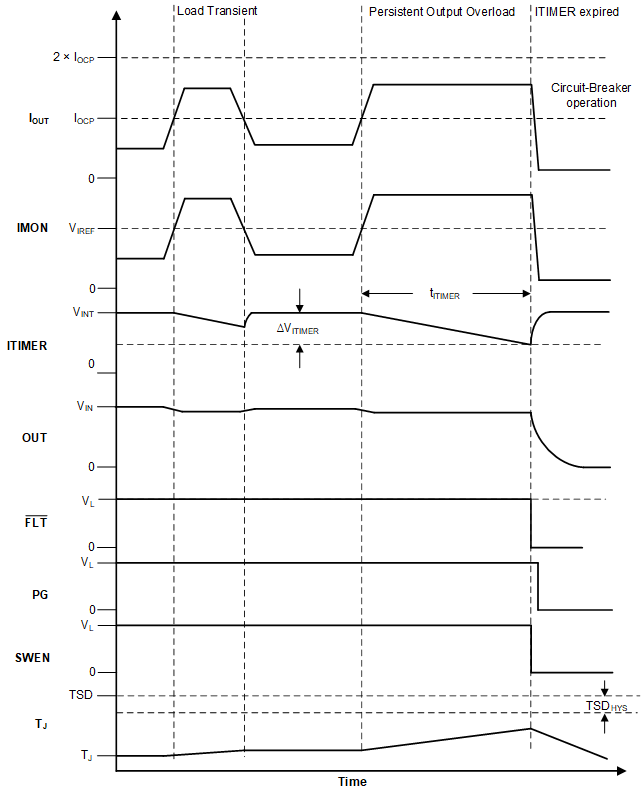 Figure 4-1 Steady-State Over-current (Circuit-Breaker) Response
The device constantly senses the output load current and provides an analog current output (IIMON) on the IMON pin, which is proportional to the load current. This in turn produces a proportional voltage (VIMON) across the IMON pin resistor (RIMON) as per Equation 1.
Where GIMON is the current monitor gain (IIMON : IOUT)
The over-current condition is detected by comparing this voltage against the voltage on the IREF pin as a reference. The reference voltage (VIREF) sets the over-current protection threshold (IOCP) accordingly.
- In the standalone or primary mode of operation,
the internal current source interacts with the external IREF pin resistor
(RIREF) to generate the reference voltage. It is also possible to
drive the IREF pin from an external low impedance reference voltage source as
shown in Equation 2. Equation 2.
- In a primary and secondary parallel configuration, the primary eFuse or controller drives the voltage on the IREF pin to provide an external reference (VIREF) for all the secondary devices in the chain.
The over-current protection threshold during steady-state (IOCP) can be calculated using Equation 3.
After an over-current condition is detected, that is the load current exceeds the programmed current limit threshold (IOCP), but stays lower than the scalable short-circuit threshold (ISFT) of 2 × IOCP, the device starts discharging the ITIMER pin capacitor using an internal pull-down current (ITIMER) of ~ 2.0μA. If the load current drops below the circuit-breaker threshold before the ITIMER capacitor discharges by ΔVITIMER of 1.5V (typical), the ITIMER is reset by pulling it up to VINT of 3.65V (typical) internally and the circuit-breaker action is not engaged. This action allows short overload transient pulses to pass through the device without tripping the circuit. If the over-current condition persists, the ITIMER capacitor continues to discharge and after it falls by ΔVITIMER, the circuit-breaker action turns off the device immediately. At the same time, the ITIMER cap is charged up to VINT again immediately so that it is at its default state before the next over-current event. This action makes sure the full blanking timer interval is provided for every over-current event. Equation 4 can be used to calculate the RIMON value for the desired over-current threshold.
The duration for which transients are allowed can be adjusted using an appropriate capacitor value from ITIMER pin to ground. The transient over-current blanking interval can be calculated using Equation 5.
Figure 4-1 illustrates the over-current response for TPS25984, TPS25985, TPS25990, and TPS1685 eFuses. After the part shuts down due to a circuit-breaker fault, the part either stays latched off (latch-off variant) or restarts automatically after a fixed delay (auto-retry variant).
Figure 4-2 and Figure 4-3 represent the responses of TPS25990 eFuse to a transient overload event and a persistent overload event.
Figure 4-2: Device in steady-state, Load current ramped up from 50A to 70A for 10ms and then ramped down to 50A. OCP threshold set to 55A, Over-current blanking delay set to 15ms (OC_TIMER = 0x89)
Figure 4-3: Device in steady-state, Load current ramped up from 50A to 70A for > 15ms. OCP threshold set to 55A, Over-current blanking delay set to 15ms (OC_TIMER = 0x89)
 Figure 4-2 Transient Over-Current Blanking in TPS25990
eFuse
Figure 4-2 Transient Over-Current Blanking in TPS25990
eFuse Figure 4-3 Over-current Protection in TPS25990 eFuse