SLVAFY5 May 2025 TPS1685 , TPS1689 , TPS25984 , TPS25985
3.3 Parallel Operation with Active Current Sharing (ACS)
To solve the problem stated in Section 3.2, TI eFuses implement ACS, which is triggered when the current crosses a certain threshold. The active current sharing loop works by regulating the Rdson of the FETs. The eFuse carrying higher current increases the Rdson slightly to reduce current and allow other devices in the chain to take higher current, thus achieving redistribution or balancing of the current.
Setting ACS threshold low can increase the overall resistance in the path, which increases the power loss or self-heating unnecessarily at lower currents. At the same time, this does not yield any benefit in terms of long-term reliability.
The active current sharing threshold needs to be set at the maximum rated DC current for each device. The best choice is to set this close to the overcurrent protection threshold of each device. Note, that this is the overcurrent threshold which is not affected by the mismatches. This makes sure that once the system load current start approaching the max DC current, the active current sharing kicks in. This is particularly helpful from a long-term reliability perspective if the system is operating in this region for extended periods of time. Once the load current increases further beyond this point (during load transients or faults), the active current sharing loop is deactivated and the device relies on the overcurrent protection circuit (with blanking timer) instead.
Current threshold where the device goes into active current sharing depends upon VREF and RILIM value. TPS1685 design calculator can be used to determine RIREF , VIREF and RILIM value.
Equation 3 is used to determine RILIM resistance based on ACS threshold.
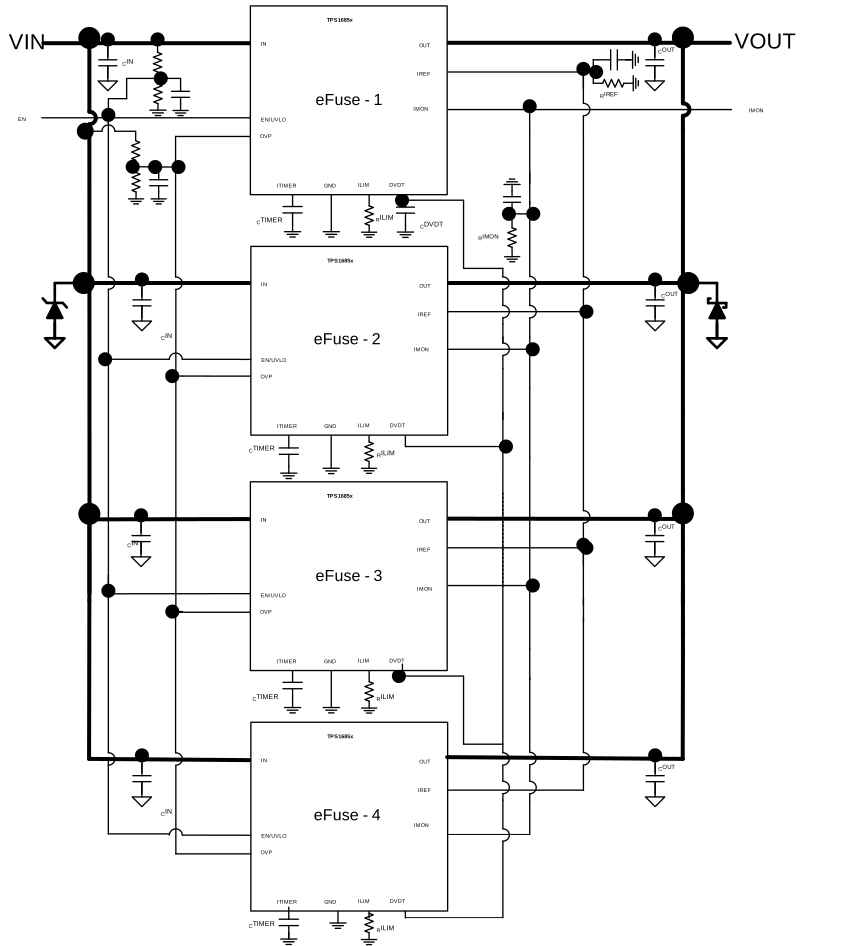 Figure 3-4 eFuse Devices Connected in
Parallel with Common Over Current Limit and ACS to Support 80A Load
Current
Figure 3-4 eFuse Devices Connected in
Parallel with Common Over Current Limit and ACS to Support 80A Load
CurrentTo evaluate the performance, load current is increased in steps of 2A as shown in Figure 3-5. Due to mismatch in path resistance, eFuses can be seen carrying unequal current distribution initially during the current step. Current through individual eFuse can be seen converging together with ACS.
This waveform is taken with system parameters as discussed in Table 3-1.
 Figure 3-5 Current Sharing Among Four TPS1685 eFuses with ACS
The TPS1685x implements a proprietary current balancing mechanism during start-up, which allows multiple TPS1685x devices connected in parallel to share the inrush current and distribute the thermal stress across all the devices. This feature helps to complete a successful start-up with all the devices and avoid a scenario where some of the eFuses hit thermal shutdown prematurely. This increases the inrush current capability of the parallel chain. The improved inrush performance helps to support very large load capacitors on high current platforms without compromising the inrush time or system reliability.
 Figure 3-6 Current Distribution Among Four TPS1685 eFuses During Start-up
Current Distribution in Six eFuse Devices in Parallel with ACS
This example discusses six TPS1685 eFuses connected in parallel with a 100A system current requirement. From the TPS1685x 9V–80V, 3.65mΩ, 20A Stackable Integrated Hotswap (eFuse) With Accurate and Fast Current Monitor data sheet, the typical RDS(on) is 3mΩ and can be as high as 6mΩ. Table 3-3 shows an example of RDS(on) variation among six eFuses devices connected in parallel with max system current of 100A . Current distribution among eFuses can be seen in Table 3-3 . eFuse_1 current can be as high as 23.07A, which is 15% higher than the recommended operating current of eFuse.
ACS (Active Current Sharing) adjusts the RDS(on) of the high current devices to evenly distribute current. The ACS threshold for this current can be set using TPS1685 design calculator. The following are the individual eFuse currents if ACS is enabled and the ACS threshold of the devices are set to 20A. Table 3-4 shows the RDS(on) variation and current distribution with ACS. There is no change in RDS(on) of eFuse_2, eFuse_3, eFuse_4 , eFuse_5 and eFuse_6, while RDS(on) of eFuse_1 is increased by 30% to make the current distribution more uniform. With ACS, current on eFuse_1 is reduced from 23.07A to 18.57A and stress is redistributed evenly and eFuse_1 life time is improved by around 2x (can be computed by using Black’s equation). This results in 2x effective system lifetime improvement, considering the first point of failure decides the system reliability.
eFuse_N | eFuse_1 | eFuse_2 | eFuse_3 | eFuse_4 | eFuse_5 | eFuse_6 |
RDS(on) | 0.0035Ω | 0.0055Ω | 0.005Ω | 0.0045Ω | 0.006Ω | 0.0055Ω |
| Max current | 23.07A | 14.7A | 16.15A | 17.9A | 13.46A | 14.7A |
eFuse_N | eFuse_1 | eFuse_2 | eFuse_3 | eFuse_4 | eFuse_5 | eFuse_6 |
RDS(on) | 0.00455Ω | 0.0055Ω | 0.005Ω | 0.0045Ω | 0.006Ω | 0.0055Ω |
| Max current | 18.75A | 14.7A | 15.5A | 17.06A | 14.2A | 15.5A |