SLVUDF6 September   2025


  1.   1
  2.   Description
  3.   Get Started
  4.   Features
  5.   Applications
  6.   6
  7. 1Evaluation Module Overview
    1. 1.1 Introduction
    2. 1.2 Kit Contents
    3. 1.3 System Description
      1. 1.3.1 Key System Specifications
      2. 1.3.2 End Equipment
      3. 1.3.3 Electricity Meter
    4. 1.4 Device Information
  8. 2Hardware
    1. 2.1 System Overview
      1. 2.1.1 Block Diagram
      2. 2.1.2 Design Considerations
        1. 2.1.2.1 Voltage Measurement - Analog Front End
        2. 2.1.2.2 Current Measurement - Analog Front End
        3. 2.1.2.3 Input Voltage
  9. 3Software
    1. 3.1 Metrology Overview
      1. 3.1.1 Metrology Formulas
      2. 3.1.2 UART for PC GUI Communication
      3. 3.1.3 Direct Memory Access (DMA)
      4. 3.1.4 ADC Setup
      5. 3.1.5 Foreground Process
      6. 3.1.6 Background Process
      7. 3.1.7 Software Function per_sample_dsp ()
      8. 3.1.8 Frequency Measurement and Cycle Tracking
      9. 3.1.9 LED Pulse Generation
  10. 4Implementation Results
    1. 4.1 Evaluation Procedure
      1. 4.1.1 Equipment Setup
      2. 4.1.2 Test Procedure
        1. 4.1.2.1 Working with the Metrology GUI
        2. 4.1.2.2 Calibration
          1. 4.1.2.2.1 Voltage and Current Offset Calibration
          2. 4.1.2.2.2 Voltage and Current Gain Calibration
          3. 4.1.2.2.3 Active Power Gain Calibration
          4. 4.1.2.2.4 Offset Calibration
          5. 4.1.2.2.5 Phase Calibration
    2. 4.2 Performance Data and Results
      1. 4.2.1 Electricity Meter Metrology Accuracy Results
  11. 5Hardware Design Files
    1. 5.1 Schematics
    2. 5.2 PCB Layouts
    3. 5.3 Bill of Materials (BOM)
  12. 6Additional Information
    1. 6.1 Trademarks
  13. 7Compliance Information
    1. 7.1 Compliance and Certifications
  14. 8Related Documentation

Block Diagram

Figure 2-1 shows that for voltage sensing, the choice of voltage divider resistors for the voltage channel is selected to make sure the Mains voltage is divided down to adhere to the normal input ranges of the AMC130M02 device. Since the AMC130M02 ADCs have a large dynamic range and a large dynamic range is not needed to measure voltage, the voltage front-end circuitry is purposely selected so that the maximum voltage seen at the inputs of the voltage channel ADCs are only a fraction of the full-scale voltage. By reducing the voltage fed to the AMC130M02 voltage ADC, voltage-to-current crosstalk, which actually affects metrology accuracy more than voltage ADC accuracy, is reduced at the cost of voltage accuracy. For current sensing, a SHUNT resistor is selected based on the current range required for energy measurements and also the minimization of the maximum power dissipation of the shunt.
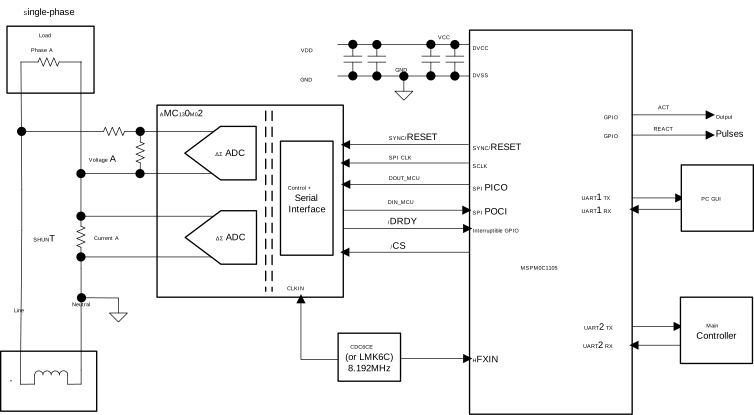
AMC-ADC-1PH-EVM AMC-ADC-1PH-EVM Block DiagramFigure 2-1 AMC-ADC-1PH-EVM Block Diagram

In this design, the AMC130M02 device interacts with MSPM0 MCU in the following manner:

  1. The clock for both MSPM0 and AMC130M02 are from the same oscillator.
  2. When new ADC samples are ready, the AMC130M02 device asserts the DRDY pin, which alerts the MSPM0 MCU that new samples are available.
  3. After being alerted of new samples, the MSPM0 MCU uses one of the SPIs and the DMA to get the voltage and current samples from the AMC130M02 device
  4. In addition, the MCU also communicates to a PC GUI through UART connection on J12.
  5. ACT and REACT output signals from the MCU represent the active and reactive energy pulses used for measuring energy consumption.