SLYT848 February 2024 LM74700-Q1 , LM74900-Q1
4 Priority power multiplexer configuration
A priority power multiplexer automatically transitions the primary power supply to an auxiliary (AUX) or secondary power supply when the primary supply voltage drops below a designated threshold. When available and within acceptable limits, the primary power supply is always the first source for powering the load. For example, if an upstream smart fuse in a power distribution unit trips on the primary power supply to a subsystem, the priority power multiplexer circuit automatically connects the AUX supply to the output and disconnects the primary supply from that output to avoid any disruptions in the subsystem operation. If the upstream smart fuse is reset and the primary supply voltage rises to an acceptable threshold, then the priority power multiplexer circuit automatically connects the primary supply back to the output and disconnects the AUX supply.
A power multiplexer circuit requires a controller such as the LM74800-Q1 or LM74900-Q1 to control two back-to-back MOSFETs on each power-supply rail. When both primary and AUX power supplies are present and within the acceptable range, and the primary is powering the load, the AUX path controller must block reverse current when the primary power-supply voltage is higher than the AUX supply. Likewise, the AUX path controller must block forward current when the primary voltage is lower than the AUX. This ensures that the primary supply, which has the highest priority, powers the load and the AUX supply is isolated from both the primary supply and the load.
The LM74900-Q1 ideal diode controller drives and controls external back-to-back N-channel MOSFETs to emulate an ideal diode rectifier with power path on or off control and overcurrent and overvoltage protection. Figure 5 is a schematic for a priority power multiplexer using two LM74900-Q1 devices in a common drain topology. The overvoltage pin of the LM74900-Q1 in the VAUX path is configured such that the VAUX power supply connects to the load immediately when VPRIM is disconnected for any reason and ensures continuous supply to the load.
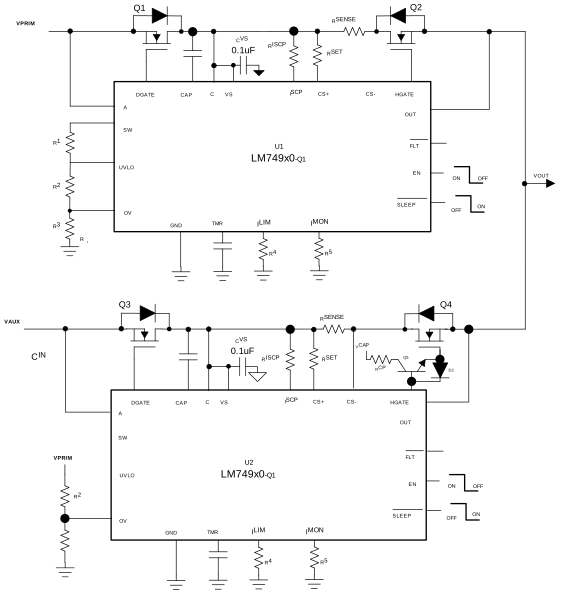 Figure 5 Typical priority power
multiplexer application circuit using the LM74900-Q1.
Figure 5 Typical priority power
multiplexer application circuit using the LM74900-Q1.A power multiplexer circuit aims to keep the output voltage drop low while the load switches to power from VAUX when VPRIM is cut off or out of the acceptable range. To keep the output voltage drop low during the transition, the load switch FET (Q4), driven by the LM74900-Q1 in the VAUX path, must be turned on very quickly while the power path of the VPRIM is turned off (by turning off Q2). But the HGATE pin is designed to source only 55μA of gate current to achieve slow startup for inrush current limiting, which is too low to turn the HGATE high quickly. A small circuit with a resistor (RCP), a transistor (Q5) and a diode (D2) can increase the HGATE source current. It is also possible to increase the gate source current by connecting the emitter of Q5 to the gate of Q4, as Q5 allows the charge-pump capacitor to pull the HGATE high directly. Alternately, you could adjust the Q4 gate source current by changing the resistor value of RCP. D2 provides a path around Q5 to turn off Q4.
Figure 6 shows the waveform captured during the instance that VPRIM disconnects and the load transitions to the VAUX rail quickly. The HGATE of the AUX rail turns on within 20µs to reduce the drop-in output voltage.
 Figure 6 VPRIM to
VAUX switchover in a power multiplexer application
Figure 6 VPRIM to
VAUX switchover in a power multiplexer applicationFigure 7 shows a waveform of the instant when VPRIM recovers back to an acceptable level and the priority power multiplexer circuit smoothly transitions the load with minimal voltage drop to VPRIM, as it has higher priority over VAUX.
 Figure 7 VAUX to
VPRIM switchover in a power multiplexer application.
Figure 7 VAUX to
VPRIM switchover in a power multiplexer application.Table 1 shows various ideal diode controllers and the redundant supply topologies that they can support based on individual feature sets.
| Ideal diode controller | ORing configuration | Power multiplexing configuration (back-to-back FET control) | |
|---|---|---|---|
| Common drain topology | Common source topology | ||
| LM5050-1-Q1 | ✓ | × | × |
| LM70700-Q1 | ✓ | × | × |
| LM7480-Q1 | ✓ | ✓ | ✓ |
| LM74720-Q1 | ✓ | ✓ | × |
| LM74900-Q1 | ✓ | ✓ | × |
| LM74930-Q1 | ✓ | × | ✓ |