TIDUFB8 December 2024
- 1
- Description
- Resources
- Features
- Applications
- 6
- 1System Description
- 2System Overview
- 3Hardware, Software, Testing Requirements, and Test Results
- 4Design and Documentation Support
- 5About the Author
2.3.1 AMC130M02
The AMC130M02 is a precision, two-channel, data and power-isolated, simultaneous-sampling, 16-bit, delta-sigma (ΔΣ), analog-to-digital converter (ADC). The AMC130M02 offers wide dynamic range, low power, and energy-measurement-specific features designed for energy metering and power metrology applications. The ADC inputs can be directly interfaced to a resistor-divider network or a shunt current sensor because of the device high input impedance.
The AMC130M02 features a fully integrated isolated DC/DC converter that allows single-supply operation from the low-side of the device. The reinforced capacitive isolation barrier is certified according to VDE 0884-17 and UL1577. This isolation barrier separates parts of the system that operate on different common-mode voltage levels and protects lower-voltage parts from damage, making the AMC130M02 an excellent choice for polyphase energy metering applications using shunt current sensors.
An integrated negative charge pump allows absolute input voltages as low as 1.3V below HGND, which enables measurements of input signals varying around ground with a single-ended power supply. The device features a programmable gain amplifier (PGA) with gains up to 128. An integrated input precharge buffer enabled at gains greater than 4 provides high input impedance at high PGA gain settings. The ADC receives the reference voltage from an integrated 1.2V reference. The device allows differential input voltages as large as the reference. Two power-scaling modes allow designers to trade power consumption for ADC dynamic range. Each ADC channel on the AMC130M02 contains a digital decimation filter that demodulates the output of the ΔΣ modulators. The filter enables data rates as high as 64kSPS per channel in high-resolution mode. The relative phase of the samples can be configured between channels, thus enabling an accurate compensation for the sensor phase response. Offset and gain calibration registers can be programmed to automatically adjust output samples for measured offset and gain errors. Figure 2-5 provides a detailed diagram of the AMC130M02
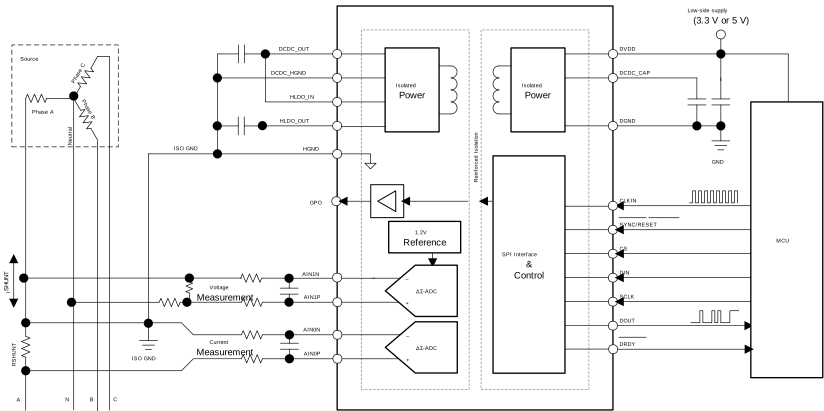 Figure 2-5 AMC130M02 Functional Block
Diagram
Figure 2-5 AMC130M02 Functional Block
Diagram