SNOS631E November 1994 – March 2025 LMC6061 , LMC6062 , LMC6064
PRODUCTION DATA
- 1
- 1Features
- 2Applications
- 3Description
- 4Pin Configuration and Functions
- 5Specifications
- 6Application and Implementation
- 7Device and Documentation Support
- 8Revision History
- 9Mechanical, Packaging, and Orderable Information
Package Options
Refer to the PDF data sheet for device specific package drawings
Mechanical Data (Package|Pins)
- D|14
Thermal pad, mechanical data (Package|Pins)
Orderable Information
6.1.2 Compensating For Input Capacitance
Large values of feedback resistance are quite common for amplifiers with ultra-low input current, like the LMC606x. Although the LMC606x is highly stable over a wide range of operating conditions, take certain precautions to achieve the desired pulse response when a large feedback resistor is used. Large feedback resistors and even small values of input capacitance, due to transducers, photodiodes, and circuit board parasitics, reduce phase margins.
When high input impedances are demanded, guarding of the LMC606x is suggested. Guarding input lines can not only reduce leakage, but also lower stray input capacitance. See also Section 6.3.1.1.
The effect of input capacitance can be compensated for by adding a capacitor. Place a capacitor, CF, around the feedback resistor (as in Figure 6-1 ) such that:
where
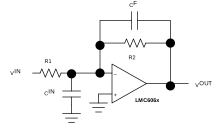 Figure 6-1 Canceling the Effect of Input
Capacitance
Figure 6-1 Canceling the Effect of Input
CapacitanceThe exact value of CIN is often difficult to know, but CF can be experimentally adjusted so that the desired pulse response is achieved. For a more detailed discussion on compensating for input capacitance, see the LMC660 and the LMC662.