SNOS719H September 1999 – January 2025 LMC7101Q-Q1
PRODUCTION DATA
- 1
- 1 Features
- 2 Applications
- 3 Description
- 4 Pin Configuration and Functions
-
5 Specifications
- 5.1 Absolute Maximum Ratings
- 5.2 ESD Ratings
- 5.3 Recommended Operating Conditions
- 5.4 Thermal Information
- 5.5 Electrical Characteristics for VS = 2.7V or ±1.35V
- 5.6 Electrical Characteristics for VS = 3V or ±1.5V
- 5.7 Electrical Characteristics for VS = 5V or ±2.5V
- 5.8 Electrical Characteristics for VS = 15V or ±7.5V
- 5.9 Typical Characteristics for VS = 2.7V
- 5.10 Typical Characteristics for VS = 3V
- 5.11 Typical Characteristics for VS = 5V
- 5.12 Typical Characteristics for VS = 15V
- 6 Detailed Description
- 7 Application and Implementation
- 8 Device and Documentation Support
- 9 Revision History
- 10Mechanical, Packaging, and Orderable Information
Package Options
Refer to the PDF data sheet for device specific package drawings
Mechanical Data (Package|Pins)
- DBV|5
Thermal pad, mechanical data (Package|Pins)
Orderable Information
7.2 Typical Application
Figure 7-3 shows a high input impedance noninverting circuit. This circuit gives a closed-loop gain equal to the ratio of the sum of R1 and R2 to R1 and a closed-loop 3dB bandwidth equal to the amplifier unity-gain frequency divided by the closed-loop gain. This design has the benefit of a very high input impedance, which is equal to the differential input impedance multiplied by loop gain (open loop gain / closed loop gain). In dc-coupled applications, input impedance is not as important as input current and the voltage drop across the source resistance. The amplifier output can go into saturation if the input is allowed to float, which can be important if the amplifier must be switched from source to source.
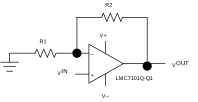 Figure 7-3 Example
Application
Figure 7-3 Example
Application