SCDS383F August 2018 – July 2025 TMUX6111 , TMUX6112 , TMUX6113
PRODUCTION DATA
- 1
- 1 Features
- 2 Applications
- 3 Description
- 4 Device Comparison Table
- 5 Pin Configuration and Functions
-
6 Specifications
- 6.1 Absolute Maximum Ratings
- 6.2 ESD Ratings
- 6.3 Thermal Information
- 6.4 Recommended Operating Conditions
- 6.5 Electrical Characteristics (Dual Supplies: ±15V)
- 6.6 Switching Characteristics (Dual Supplies: ±15V)
- 6.7 Electrical Characteristics (Single Supply: 12V)
- 6.8 Switching Characteristics (Single Supply: 12V)
- 6.9 Typical Characteristics
- 7 Parameter Measurement Information
- 8 Detailed Description
- 9 Application and Implementation
- 10Device and Documentation Support
- 11Revision History
- 12Mechanical, Packaging, and Orderable Information
Package Options
Mechanical Data (Package|Pins)
Thermal pad, mechanical data (Package|Pins)
- RTE|16
Orderable Information
8.1.10 THD + Noise
The total harmonic distortion (THD) of a signal is a measurement of the harmonic distortion, and is defined as the ratio of the sum of the powers of all harmonic components to the power of the fundamental frequency at the mux output. The on-resistance of the TMUX6111, TMUX6112, and TMUX6113 varies with the amplitude of the input signal and results in distortion when the drain pin is connected to a low-impedance load. Total harmonic distortion plus noise is denoted as THD+N. Figure 8-10 shows the setup used to measure THD+N of the TMUX6111, TMUX6112, and TMUX6113.
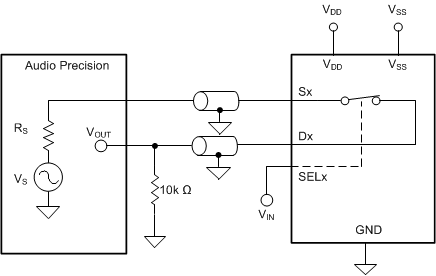 Figure 8-10 THD+N Measurement Setup