SNVSCU1A July 2025 – November 2025 TPSM65630
PRODUCTION DATA
- 1
- 1 Features
- 2 Applications
- 3 Description
- 4 Device Comparison Table
- 5 Pin Configuration and Functions
- 6 Specifications
-
7 Detailed Description
- 7.1 Overview
- 7.2 Functional Block Diagram
- 7.3
Feature Descriptions
- 7.3.1 Output Voltage Selection
- 7.3.2 EN Pin and Use as VIN UVLO
- 7.3.3 Mode Selection
- 7.3.4 Adjustable Switching Frequency
- 7.3.5 Dual Random Spread Spectrum (DRSS)
- 7.3.6 Internal LDO, VCC UVLO, and BIAS Input
- 7.3.7 Bootstrap Voltage (BST Pin)
- 7.3.8 Soft Start and Recovery From Dropout
- 7.3.9 Safety Features
- 7.4 Device Functional Modes
- 8 Application and Implementation
- 9 Device and Documentation Support
- 10Revision History
- 11Mechanical, Packaging, and Orderable Information
7.3.1 Output Voltage Selection
The TPSM656x0 features pin-selectable fixed output voltage or adjustable output voltage mode. In fixed output voltage mode, the output voltage is selected by the FB pin. Connect the FB pin to GND to select the fixed 3.3V output, or connect to VCC for a fixed 5V output. When the fixed output voltage mode is selected, the BIAS pin is connected directly to VOUT. In this mode, the BIAS pin closes the feedback loop of the regulator and provides input power to the internal bias regulator. Because of the internal LDO is supplied through this pin, a reliable bode plot cannot be taken in fixed output voltage mode however this measurement can be take in adjustable mode. Connect BIAS to VOUT as shown in Figure 8-1.
| FB | VOUT |
|---|---|
| Short to GND | 3.3V |
| Short to VCC | 5V |
| Connect to a feedback resistor divider (Figure 7-1) | ADJ |
In the adjustable output voltage mode, a voltage divider is connected between the regulator output voltage and the FB pin. The resistor values are calculated based on the desired output voltage and the 0.8V reference of the regulator. See Figure 7-1 for detailed connections.
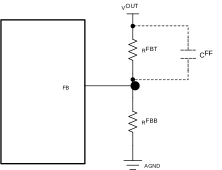 Figure 7-1 Setting Output Voltage of Adjustable Versions
Use Equation 1 to select a value for RFBB, based on a desired value of RFBT. Limiting the value of RFBT to 100kΩ or less is best practice. Larger values of resistance are susceptible to leakage currents on the PCB, caused by environmental contamination, that can shift the desired output voltage. Values up to about 1MΩ can be used to reduce the no-load supply current, in those cases where excessive PCB leakage currents are not present.
In some cases, when using the adjustable mode, a feed forward capacitor can be used to improve the loop phase margin or load transient response. The exact value of CFF is best selected empirically during the initial bench evaluation of the design. Leave a placeholder for this capacitor in the PCB layout if needed at some stage during development.
| VOUT (V) | RFBT (kΩ) | RFBB (kΩ) | RECOMMENDED FSW (kHz) | COUT(MIN) (µF) (EFFECTIVE) |
|---|---|---|---|---|
| 1.8 | 205 | 164 | 400 | 200 |
| 3.3 | 205 | 65.7 | 650 | 75 |
| 5 | 205 | 39 | 1000 | 40 |
| 12 | 205 | 14.7 | 1800 | 15 |
| 24 | 205 | 7 | 2200 | 10 |