SNVSCU1A July 2025 – November 2025 TPSM65630
PRODUCTION DATA
- 1
- 1 Features
- 2 Applications
- 3 Description
- 4 Device Comparison Table
- 5 Pin Configuration and Functions
- 6 Specifications
-
7 Detailed Description
- 7.1 Overview
- 7.2 Functional Block Diagram
- 7.3
Feature Descriptions
- 7.3.1 Output Voltage Selection
- 7.3.2 EN Pin and Use as VIN UVLO
- 7.3.3 Mode Selection
- 7.3.4 Adjustable Switching Frequency
- 7.3.5 Dual Random Spread Spectrum (DRSS)
- 7.3.6 Internal LDO, VCC UVLO, and BIAS Input
- 7.3.7 Bootstrap Voltage (BST Pin)
- 7.3.8 Soft Start and Recovery From Dropout
- 7.3.9 Safety Features
- 7.4 Device Functional Modes
- 8 Application and Implementation
- 9 Device and Documentation Support
- 10Revision History
- 11Mechanical, Packaging, and Orderable Information
7.3.8 Soft Start and Recovery From Dropout
When designing with the TPSM656x0, slower rise in output voltage due to recovery from dropout and soft start must be considered separate phenomena. Soft start is triggered by any of the following conditions:
- EN is used to turn on the device.
- Recovery from a hiccup waiting period; see Section 7.3.9.3.
- Recovery from shutdown due to overtemperature protection.
- Power is applied to the VIN of the IC or the VCC UVLO is released.
After soft start is initiated, the IC takes the following actions:
- The reference used by the IC to regulate output voltage is slowly ramping up from zero. The net result is that output voltage, if previously 0V, takes tSS to reach 90% of regulation value.
- Operating mode is set to auto, activating diode emulation. This action allows start-up without pulling the output voltage low if there is a voltage already present on the output.
- Hiccup is disabled for the duration of soft start; see Section 7.3.9.3.
All of these actions together provide a controlled start-up with limited inrush current. These actions also allow the use of output capacitors and loading conditions that can cause current limit during start-up without triggering hiccup. In addition, if the output voltage is already present the output voltage does not discharge.
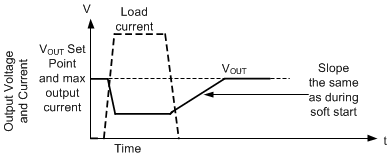
Any time the output voltage is more than a few percent low for any reason, the output voltage ramps back up slowly. This action is the recovery from dropout condition which differs from soft start in three important ways:
- Hiccup is allowed only if output voltage is less than 40 percent the set point. Note that during dropout regulation, hiccup is inhibited. See Section 7.3.9.3.
- FPWM mode is allowed during recovery from dropout. If the output voltage is suddenly pulled up by an external supply, the TPSM656x0 can pull down on the output. Note that all the protections that are present during normal operation are in place, protecting the device if output is shorted to a high voltage or ground.
- The reference voltage is set to approximately 1% above that needed to achieve the current output voltage. The reference voltage is not started from zero.
Despite the name, recovery from dropout is active whenever output voltage is more than a few percent lower than the setpoint for long enough that:
- Duty factor is controlled by minimum on-time or
- When the part is operating in current limit.
This action primarily occurs under the following conditions:
- Dropout: When there is insufficient input voltage for the desired output voltage to be generated.
- Overcurrent that is not severe enough to trigger hiccup or if the duration is too short to trigger hiccup. See Section 7.3.9.3.