DLPA037A June 2013 – August 2025 DLP500YX , DLP5500 , DLP6500FLQ , DLP6500FYE , DLP650LNIR , DLP670S , DLP7000 , DLP7000UV , DLP9000 , DLP9000X , DLP9000XUV , DLP9500 , DLP9500UV
2.5 The DLP© DMD as a Two Dimensional Grating
DMDs employ square mirrors so that ax = ay and dx = dy so from here on we only refer to “a” and “d”. Furthermore, the mirror tilts +/- thetatilt about an axis that runs diagonally on the pixel. The result is that the only orders the envelope can be centered on lie along the line of the m = n orders.
 Figure 2-5 3D
Hemisphere View Of Orders
Figure 2-5 3D
Hemisphere View Of Orders  Figure 2-7 View
of Numbered Orders And Envelope Center for a DMD
Figure 2-7 View
of Numbered Orders And Envelope Center for a DMD  Figure 2-6 View
of Orders From Above (mapped Space)
Figure 2-6 View
of Orders From Above (mapped Space)The objective then, for most applications, is to arrange the geometries so that for the wavelength of interest the envelope center lines up with an order. For the DMD the pitch and mirror tilt are fixed. However, try moving the incident angle to arrange a blaze for a given (n,n) order. In the following illustration the (n,n) order is refered to simply as the nth order. The following illustration shows the relationship between incident angle, tilt angle and blaze.
Please notice that along this line x = y so that the Envelope function is falling off as Sinc4. This means that when the DMD switches from on to off the intensity of the orders that were previously blazed have excellent extinction.
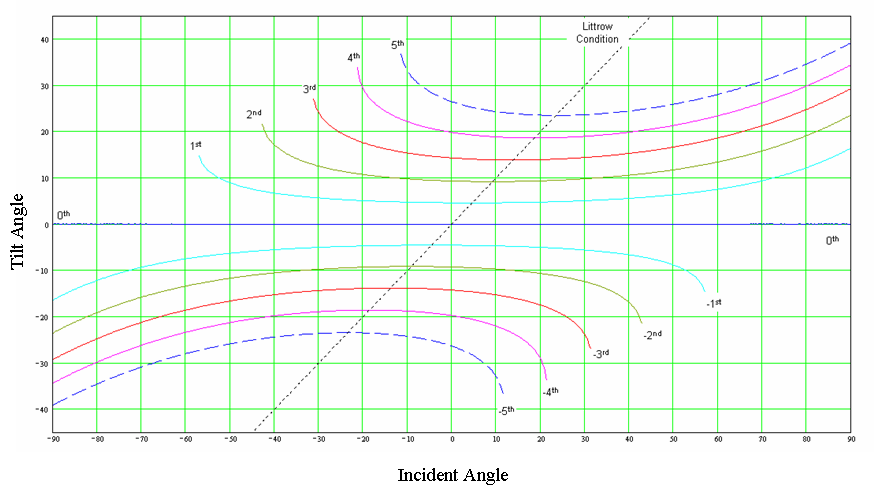 Figure 2-8 Relationship Between Incident, Tilt and Blaze
Notice the special blaze condition (represented by the dashed diagonal line) where the incident angle and the tilt angle are the same. This is known as the Littrow condition and is advantageous when using the same optics for inbound and outbound light.