DLPA037A June 2013 – August 2025 DLP5500 , DLP6500FLQ , DLP6500FYE , DLP650LNIR , DLP670S , DLP7000 , DLP7000UV , DLP9000 , DLP9000X , DLP9000XUV , DLP9500 , DLP9500UV
2.4 Extending to Two Dimensional Gratings
Armed with the understanding of 1D grating diffraction we can extend this same understanding to two dimensions. We restrict our consideration to a grating with two orthogonal groove systems. Let the new dimensions be ax and ay for the face dimensions (mirror) and dx and dy for the grating pitches.
Now, orders are no longer lines, but rather, since the orders are constrained in two dimensions to particular directions the orders become dots on our mapped space. These orders are located at with the (0,0) order at the specular grating reflection and a envelope centered on the specular reflection of the faces. A link showing a 2D (no tilt) pattern can be found at: 2D Grating
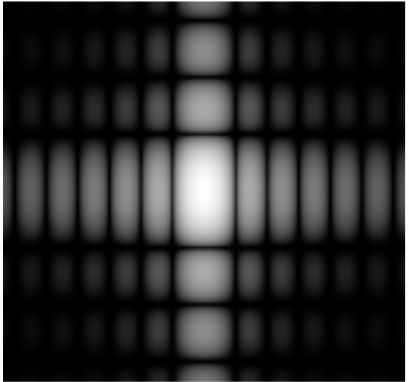 Figure 2-4 2D Sinc envelope
(grayscale)
Figure 2-4 2D Sinc envelope
(grayscale)As before all the light that is incident on the array must be accounted for. Some is lost in the fill factor, but the remaining light must go into the real space. As in the 1D case we can renormalize to determine the light going into each order for a given set of geometries, wavelength and incident angle.