SLAAE75B March   2023  – May 2023 MSPM0L1105 , MSPM0L1106 , MSPM0L1303 , MSPM0L1304 , MSPM0L1304-Q1 , MSPM0L1305 , MSPM0L1305-Q1 , MSPM0L1306 , MSPM0L1306-Q1 , MSPM0L1343 , MSPM0L1344 , MSPM0L1345 , MSPM0L1346


  1.   1
  2.   Abstract
  3.   Trademarks
  4. MSPM0L Hardware Design Checklist
  5. Power Supplies in MSPM0L Devices
    1. 2.1 Digital Power Supply
    2. 2.2 Analog Power Supply
    3. 2.3 Built-in Power Supply and Voltage Reference
    4. 2.4 Recommended Decoupling Circuit for Power Supply
  6. Reset and Power Supply Supervisor
    1. 3.1 Digital Power Supply
    2. 3.2 Power Supply Supervisor
  7. Clock System
    1. 4.1 Internal Oscillators
    2. 4.2 External Clock Output (CLK_OUT)
    3. 4.3 Frequency Clock Counter (FCC)
  8. Debugger
    1. 5.1 Debug Port Pins and Pinout
    2. 5.2 Debug Port Connection With Standard JTAG Connector
  9. Key Analog Peripherals
    1. 6.1 ADC Design Considerations
    2. 6.2 OPA Design Considerations
    3. 6.3 DAC Design Considerations
    4. 6.4 COMP Design Considerations
    5. 6.5 GPAMP Design Considerations
    6. 6.6 LCD Design Considerations
  10. Key Digital Peripherals
    1. 7.1 Timer Resources and Design Considerations
    2. 7.2 UART and LIN Resources and Design Considerations
    3. 7.3 I2C and SPI Design Considerations
  11. GPIOs
    1. 8.1 GPIO Output Switching Speed and Load Capacitance
    2. 8.2 GPIO Current Sink and Source
    3. 8.3 High Speed GPIOs
    4. 8.4 Open-Drain GPIOs Enable 5-V Communication Without a Level Shifter
    5. 8.5 Communicate With 1.8V Devices Without a Level Shifter
    6. 8.6 Unused Pins Connection
  12. Layout Guides
    1. 9.1 Power Supply Layout
    2. 9.2 Considerations for Ground Layout
    3. 9.3 Traces, Vias, and Other PCB Components
    4. 9.4 How to Select Board Layers and Recommended Stack-up
  13. 10Bootloader
    1. 10.1 Bootloader Introduction
    2. 10.2 Bootloader Hardware Design Considerations
      1. 10.2.1 Physical Communication interfaces
      2. 10.2.2 Hardware Invocation
  14. 11References
  15. 12Revision History

OPA Design Considerations

The MSPM0L OPA is a zero-drift chopper stabilized operational amplifier with a programmable gain stage. This can used for signal amplification and buffering. The OPA can work in General-purpose Mode, Buffer Mode and PGA mode.

When using the OPA in general-purpose mode, add an external resistor and capacitor to create the amplifier circuit. But when using buffer mode, the circuit can be configured in software. For PGA mode, software can configure up to 32x PGA gain.

Note: The PGA gain is only in the negative terminal.

When two or more OPAs are available on a device, the two can be combined to form a differential amplifier. The output equation for the differential amplifier is given by the Vdiff equation in Figure 6-2.

 Two OPA Differential Amplifier Block Diagram and Equation Figure 6-2 Two OPA Differential Amplifier Block Diagram and Equation

Alternately, when two or more OPAs are available on a device, the OPAs can be combined to form a multi-stage or cascaded amplifier. Using the programmable input muxes, all combinations of inverting and noninverting multi-stage amplifiers can be implemented. The output equation for the noninverting to noninverting cascaded amplifier is given by the Vout equation in Figure 6-3.
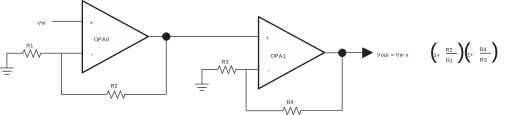
 Two OPA Noninverting to Noninverting Cascade Amplifier Block Diagram and Equation Figure 6-3 Two OPA Noninverting to Noninverting Cascade Amplifier Block Diagram and Equation