SLLA337A January 2013 – May 2025 SN55HVD233-SEP , SN55HVD233-SP , SN65HVD230 , SN65HVD231 , SN65HVD232 , SN65HVD233 , SN65HVD233-Q1 , SN65HVD234 , SN65HVD234-Q1 , SN65HVD235 , SN65HVD235-Q1 , TCAN330 , TCAN330G , TCAN332 , TCAN332G , TCAN334 , TCAN334G , TCAN337 , TCAN337G , TCAN3403-Q1 , TCAN3404-Q1 , TCAN3413 , TCAN3414
2 Measurements Demonstrating Operation
Figure 2-1 shows two 5V transceivers communicating on the same bus. In this case, transceiver (XCVR) 1 and 2 are both Texas Instruments’ SN65HVD255 CAN transceiver. The signals ‘TXD1’ and ‘TXD2’ show what each transceiver is driving onto the bus, while ‘RXD1’ and ‘RXD2’ show what each transceiver is reading from the bus. The two upper signals are the bus lines, CANH (yellow) and CANL (light blue). The red waveform below them is the calculated differential voltage between CANH and CANL.
 Figure 2-1 Waveforms of Two 5V SN65HVD255
Transceivers
Figure 2-1 Waveforms of Two 5V SN65HVD255
TransceiversA simplified bit pattern was used to demonstrate CAN bus principles.
- Bit time 1: one transceiver transmits a dominant bit while the other remains recessive.
- Bit time 2: both transceivers are recessive.
- Bit time 3: both transmit dominant, showing what can happen during arbitration.
As shown, the differential voltage is slightly greater when both transceivers are dominant due to the output transistors of each transceiver being in parallel, resulting in a smaller voltage drop and greater differential voltage output.
Figure 2-2 shows the same setup but with two 3.3V transceivers (TI SN65HVD234). The differential voltage between the bus lines during dominant bits is lower than the 5V devices that were tested, but is still meets the requirements of the ISO 11898-2 standard. In addition, the minimum differential bus voltage for the 5V devices is the same as with the 3.3V devices (1.5V). This means that designers have no advantage if choosing 5V devices for their higher differential driving abilities, since it is not specified that the differential output is higher.
 Figure 2-2 Waveforms of Two 3.3V
SN65HVD234 Transceivers
Figure 2-2 Waveforms of Two 3.3V
SN65HVD234 TransceiversFigure 2-3 shows how robust CAN is with common mode differences. The red Math signal shows the common mode voltage instead of differential voltage in previous plots. The bus signals become very ugly when arbitration between ground shifted transceivers occurs. However, the RXD1 signal shows that the transceivers don’t have a problem because the differential signal is good and the transceiver correctly detects the signal on the bus.
 Figure 2-3 Waveform of Two SN65HVD255
Transceivers, One With a +1V Ground Shift
Figure 2-3 Waveform of Two SN65HVD255
Transceivers, One With a +1V Ground ShiftFigure 2-4 shows the same situation as the previous figure, now with split termination instead of traditional single termination. Split termination, shown in Figure 2-4, helps filter out high frequency noise that can occur when there are ground potential differences between nodes. The setup for Figure 2-4 used a CL of 4.7nF, which is typical.
 Figure 2-4 Waveform of Two 5V SN65HVD255
Transceivers With Split Termination, One With a +1V Ground Shift
Figure 2-4 Waveform of Two 5V SN65HVD255
Transceivers With Split Termination, One With a +1V Ground Shift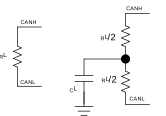 Figure 2-5 Single Termination (left) and
Split Termination (right)
Figure 2-5 Single Termination (left) and
Split Termination (right)Figure 2-6 shows communication with a mixed network of one 3.3V transceiver and one 5V transceiver. As before, the digital signals TXD1, TXD2, RXD1 and RXD2 show that both transceivers are accurately talking to each other and there is little common mode shift during the communication in contrast to the 5V homogeneous network with a 1V ground shift.
 Figure 2-6 Waveform of a 5V SN65HVD255
and a 3.3V SN65HVD234
Figure 2-6 Waveform of a 5V SN65HVD255
and a 3.3V SN65HVD234Figure 2-7 shows a CAN frame in a mixed network of two 3.3V transceivers and one 5V transceiver to demonstrate these principles in a CAN frame from a functional mixed system.
 Figure 2-7 Bus Communication of a 5V
SN65HVD1050 and a 3.3V SN65HVD230
Figure 2-7 Bus Communication of a 5V
SN65HVD1050 and a 3.3V SN65HVD230