SNOAAA8 April 2025 LM74610-Q1
1.4 Solar Power Optimizer Working Principle
Figure 1-11 through Figure 1-14 describe the solar power optimizer working principle. Suppose that the PV panel can output maximum 420 Watts (35V, 12A) when there is no shady (MPP on the blue I-V curve).
 Figure 1-11 PV System Without Solar Power
Optimizer
Figure 1-11 PV System Without Solar Power
Optimizer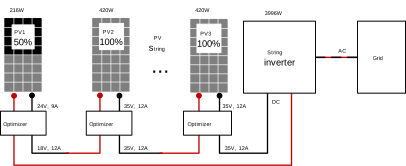 Figure 1-13 PV System With Solar Power
Optimizer
Figure 1-13 PV System With Solar Power
Optimizer Figure 1-12 PV Curve Characterization Without Solar
Power Optimizer
Figure 1-12 PV Curve Characterization Without Solar
Power Optimizer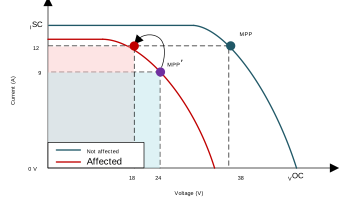 Figure 1-14 PV Curve Characterization With Solar
Power Optimizer
Figure 1-14 PV Curve Characterization With Solar
Power OptimizerThe top half part is the PV system without the optimizer. The example shows, when PV 1 is partially obscured by a leaf, the I-V curve is in green. There has no shady on PV 2 to PV 10 and the I-V curves are in light blue. Now the string inverter finds the maximum output power is in the condition of the 10A string current. This can be found that though there having no shady on PV 2 to PV 10, MPP of PV 2 to PV 10 changes from the light blue point to the purple point. The total power goes into the string inverter is 3624 Watts.
The bottom half part is the PV system with the optimizer. The example shows, when PV 1 is partially obscured by a leaf, the I-V curve is in green. There has no shady on PV 2 to PV 10 and the I-V curves are in light blue. With solar power optimizer, now the string inverter finds the maximum output power is in the condition of the 12A string current, which aligns to the MPP current of PV 2 to PV 10. So, PV 2 to PV 10 are working on the MPP. For PV 1, the MPP is at 24V 9A (dark blue point). By the simple power equilibrium principle (ideally ignore loss) of power optimizer, the output after this is changed to 18V 12A (purple point). The total power goes into the string inverter is 3996 Watts. As shown, with power optimizer, the total power goes into the string inverter increases 10.2%.
In short, power optimizer tracks the max power of each panel in real time and regulates the output voltage before sending the output to the inverter, The inverter can process much more electricity. The result is optimized power yield performance for every single panel, regardless of orientation to the sun, shady, or even damage to one or more of the panels.