SNOAAA8 April 2025 LM74610-Q1
1.2 Why, When, Where Needs MLPE
Figure 1-1 through Figure 1-4 shows I-V curves of PV cell comparing shade and no shade conditions. If no shade, the overall string characteristic curve can be regarded as the sum of each cell’s curve, as well as the MPP. If shade on Cell 1 (red), the maximum allowed current going through this rapidly decreases and the same for the string current because cells are in series with the same current. The overall string characteristic curve is pulled down by the shady cell, as well as the MPP.
 Figure 1-1 Circuit Shade
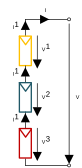 Figure 1-3 Circuit No Shade
 Figure 1-2 Graph Shade
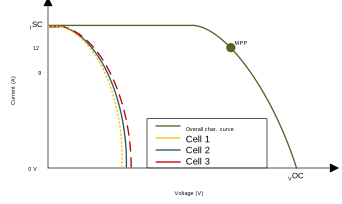 Figure 1-4 Graph No Shade
Figure 1-5 shows a rooftop PV application scenario example. There are some PV panels in different shady conditions, from no shade to almost in full shade. This means the panels corresponding I-V Curves also vary from each other, as well as the MPP. This can be seen that as the shade gradually aggravates, the power generation capability of the PV panel also gradually decreases.
 Figure 1-5 Rooftop PV Application
Scenario Example
Figure 1-5 Rooftop PV Application
Scenario ExampleHowever, for the string inverter, since PV panels are connected in series to form a string with the same string current, the power generation capability of the all PV panels are limited by the poorest one. Also, all PV panels are forced to have the same current as the poorest one having, that is known as buckets effect.
Figure 1-6 through Figure 1-9 shows the power generation effect demo of PV system in with or without shady condition.
 Figure 1-6 PV System without MLPE in
Non-Shady Condition
Figure 1-6 PV System without MLPE in
Non-Shady Condition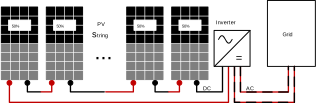 Figure 1-7 PV System without MLPE in
Shady Condition
Figure 1-7 PV System without MLPE in
Shady Condition Figure 1-8 PV System with
Micro-Inverter in Shady Condition
Figure 1-8 PV System with
Micro-Inverter in Shady Condition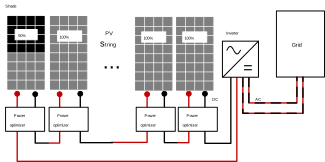 Figure 1-9 PV System with Solar Power
Optimizer in Shady Condition
Figure 1-9 PV System with Solar Power
Optimizer in Shady ConditionThe summarize, the power yield efficiency of traditional string inverter PV system is affected by some factors such as shady (surrounding buildings, trees, clouds, fallen leaves and bird droppings, and so on), PV module mismatch losses, and PV panel orientation mismatch losses (PV panels deployed on roofs with different orientation).
The reason MLPE needed is, because String inverter only achieves global MPPT, MLPE can achieve module level MPPT to improve energy production. In addition, MLPE naturally can provide compliance with module-level rapid shutdown (RSD) requirements under the National Electrical Code (NEC) and module-level monitoring and diagnostic functionality. So, when the users meet situations of low power yield efficiency, or RSD being required by local law, the user needs to consider MLPE products in the PV system. Typically, this is mostly designed for residential and small-size commercial PV system. Also note that, RSD can be a product independent from Micro-Inverter and Solar Power Optimizer. Hence, sometimes RSD is also regarded as one kind of MLPE product, though this does not improve power yield performance as Micro-Inverter and Solar Power Optimizer do, only provides shutdown function.