SPMA057E January 2018 – January 2025 TM4C1290NCPDT , TM4C1290NCZAD , TM4C1292NCPDT , TM4C1292NCZAD , TM4C1294KCPDT , TM4C1294NCPDT , TM4C1294NCZAD , TM4C1297NCZAD , TM4C1299KCZAD , TM4C1299NCZAD , TM4C129CNCPDT , TM4C129CNCZAD , TM4C129DNCPDT , TM4C129DNCZAD , TM4C129EKCPDT , TM4C129ENCPDT , TM4C129ENCZAD , TM4C129LNCZAD , TM4C129XKCZAD , TM4C129XNCZAD , TMP1826 , TMP1827
2.1 Signaling on 1-Wire®
The four types of signaling that are possible on the data line are:
- Reset Sequence with Reset Pulse and Answer to
Reset (ATR): A reset pulse is used to put all the devices in a known state.
Target devices confirm their presence by sending an ATR signal, which is done by
holding the line low. The host controller samples the bus, and if the bus reads
low, then at least one target device is present. Table 2-1 Reset Signaling Description and Implementation
Operation Description Implementation Reset Reset the 1-Wire® bus target devices and prepare them for a command. Drive the bus low for 480 µs to reset all the devices. The host then samples the bus for the next 240 µs while the target Answer to Reset (ATR). 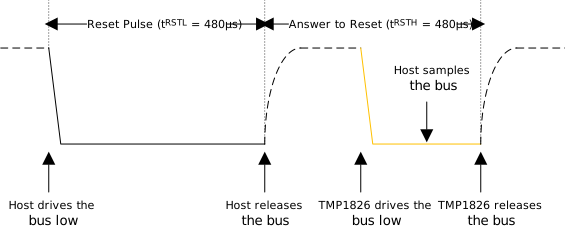 Figure 2-1 Reset Sequence Bus Timing When There is at Least 1 Device on the
Bus
Figure 2-1 Reset Sequence Bus Timing When There is at Least 1 Device on the
Bus - Write logic 0 onto the bus Table 2-2 Write Logic 0 Bit Signaling Description and Implementation
Operation Description Implementation Write logic 0 Send 0 bit to the 1-Wire® target devices Drive the bus low for 60 µs  Figure 2-2 Write Logic 0 Bus Timing
 - Write logic 1 onto the bus Table 2-3 Write Logic 1 Signaling Description and Implementation
Operation Description Implementation Write 1 bit Send 1 bit to the 1-Wire® target devices Drive the bus low for < 15 µs. Typical times are about 6 µs. Release the bus until 60 µs after the falling edge. 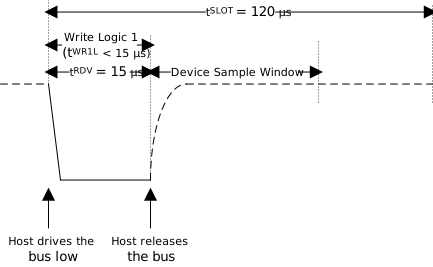 Figure 2-3 Write Logic 1 Bus Timing
 - Read bit: Reads one bit from the target devices.
Read bit signaling is similar to write “1” signaling, except that the host
controller reads instead of writes. Table 2-4 Read Bit Signaling Description and Implementation
Operation Description Implementation Read bit Read a bit from the 1-Wire® target device Drive the bus low from 1 µs to 15 µs. Sample the bus at 15 µs after the falling edge to read the bit from the target device. 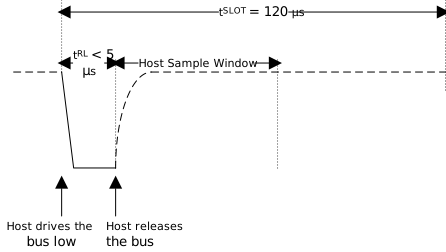 Figure 2-4 Read Logic 1 Bus Timing
 Figure 2-5 Read Logic 0 Bus Timing