TIDUF04A December 2022 – December 2025
- 1
- Description
- Resources
- Features
- Applications
- 6
- 1System Description
-
2System Overview
- 2.1 Block Diagram
- 2.2
Design Considerations
- 2.2.1
Isolated AC/DC Power Supply Design
- 2.2.1.1 Input Bulk Capacitance and Minimum Bulk Voltage
- 2.2.1.2 Transformer Turns-Ratio, Primary Inductance, and Primary Peak Current
- 2.2.1.3 Transformer Parameter Calculations: Primary and Secondary RMS Currents
- 2.2.1.4 Main Switching Power MOSFET Selection
- 2.2.1.5 Rectifying Diode Selection
- 2.2.1.6 Output Capacitor Selection
- 2.2.1.7 Capacitance on VDD Pin
- 2.2.1.8 Open-loop Voltage Regulation Versus Pin Resistor Divider, Line Compensation Resistor
- 2.2.1.9 Feedback Elements
- 2.2.1.10 Backup Power Supply
- 2.2.1.11 Supercapacitor Selection
- 2.2.1.12 Supercapacitor Charger Design
- 2.2.2 Relay Drive and Weld Detect
- 2.2.1
Isolated AC/DC Power Supply Design
- 2.3 Highlighted Products
- 3Hardware, Testing Requirements, and Test Results
- 4Design and Documentation Support
- 5About the Author
- 6Revision History
2.2.2 Relay Drive and Weld Detect
The primary functionality of the EVSE is the reliable control of large currents directed toward an electric vehicle at the mains voltage. In a normal use case, the relay or contactor must be held closed for several hours to fully charge a vehicle; however, the relays cannot be welded because of safety concerns. If something fails in the control system, the relays must fail open. These high-current relays or contactors can typically draw tens to hundreds of milliamps as an inductive load, requiring specific drive architectures.
Because of the amount of time that a relay or contactor requires to remain powered, an efficient drive device is preferred to the typical Darlington array, or even discrete transistor configuration. For this reason, the DRV8220 current controller is selected to drive the relays or contactors in the design. The DRV8220 device is designed to regulate the current with a well-controlled waveform to reduce power dissipation.
Relays and contactors use electromechanical solenoids for operation. Activation starts when EN pin voltage is pulled high either by an external driver or internal pullup. Once the EN pin is driven to GND, the DRV8220 device allows the solenoid current to decay to zero. The solenoid current is ramped up fast to enable opening of the relay or contactor. After initial ramping, the solenoid current is kept at a peak value to maintain correct operation, after which the current is reduced to a lower hold level to avoid thermal problems and reduce power dissipation.
 Figure 2-3 Typical Current Waveform Through the Solenoid
For safety reasons, detecting the output voltage of relays and contactors is critical. Due to aging and wear, contacts can suffer from arcing and can become permanently welded, resulting in a closed state that continues to supply power to the plug even when the system is off. To prevent this hazard, proper operation must be checked every time the relay is opened.
 Figure 2-4 AC Weld Detect Block Diagram
The weld detection circuit of the TIDA-010239 monitors each phase and the neutral line at the output of the contactor. Each phase is monitored through a safety capacitor. The safety capacitors provide an isolated design that also passes high-potential testing. The AC-coupled signals are first voltage- and current-limited, then combined using an ORing circuit and monitored by a single comparator. At the mains input, before the contactor, Class-X and Class-Y safety capacitors provide a current return path from the isolated ground of the charger back to the grid.
If the relay is welded, or if voltage is present at the output of the relay, the comparator drives a logic-high signal through a peak-detect circuit into the fault detection input of the MCU.
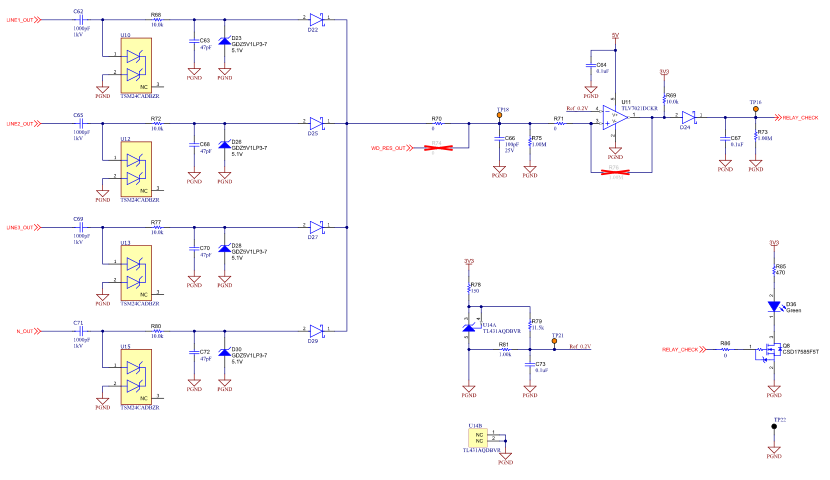 Figure 2-5 AC Weld Detect Circuit
The weld detection in this design uses the TLV7021 comparator. The TLV701x and TLV702x devices provide micropower operation with rail-to-rail input capability, combining a propagation delay of 260 ns with a quiescent supply current of only 5 µA. This balance of speed and low power enables the system to quickly detect fault conditions while minimizing energy consumption.
Internal hysteresis and immunity to output phase inversion provides robust and noise-resistant operation, which is critical when monitoring slow or distorted signals in harsh environments. The TLV7021 features an open-drain output stage, making the device an excellent choice for level shifting and flexible system integration. If a push-pull output is required, the TLV701x variant can be used instead.
The comparator reference voltage is generated by a TL431 precision programmable reference, configured to 200 mV in this design. Depending on environmental conditions and system noise levels, the reference can be set to a higher value (for example, 5 V) to increase noise immunity and prevent false triggering.