SNOSDJ6A May   2025  – October 2025 TLV9020L , TLV9022L , TLV9030L , TLV9032L

PRODMIX  

  1.   1
  2. Features
  3. Applications
  4. Description
  5. Pin Configuration and Functions
    1. 4.1 Pin Functions: TLV9020L and TLV9030L Single
    2. 4.2 Pin Configurations:TLV9022L and TLV9032L Dual
  6. Specifications
    1. 5.1 Absolute Maximum Ratings
    2. 5.2 ESD Ratings
    3. 5.3 Recommended Operating Conditions
    4. 5.4 Thermal Information - Single
    5. 5.5 Thermal Information - Dual
    6. 5.6 Electrical Characteristics
    7. 5.7 Switching Characteristics
    8. 5.8 Typical Characteristics
  7. Detailed Description
    1. 6.1 Overview
    2. 6.2 Functional Block Diagram
    3. 6.3 Feature Description
    4. 6.4 Device Functional Modes
      1. 6.4.1 Outputs
        1. 6.4.1.1 TLV902xL Open-Drain Output
        2. 6.4.1.2 TLV903xL Push-Pull Output
      2. 6.4.2 Power-On Reset (POR)
        1. 6.4.2.1 TLV902xL Open Drain Output POR Behavior
        2. 6.4.2.2 TLV903xL Push-Pull Output POR Behavior
      3. 6.4.3 Output Latching
        1. 6.4.3.1 "L1" and "L2" Power-On Options
        2. 6.4.3.2 TLV902xL1 Open-Drain Latch Behavior
        3. 6.4.3.3 TLV902xL2 Open-Drain Latch Behavior
        4. 6.4.3.4 TLV903xL1 Push-Pull Latch Behavior
        5. 6.4.3.5 TLV903xL2 Push-Pull Latch Behavior
        6. 6.4.3.6 Clear (CLR) Input
      4. 6.4.4 Inputs
        1. 6.4.4.1 Rail to Rail Input
        2. 6.4.4.2 Fail-Safe Inputs
        3. 6.4.4.3 Input Protection
        4. 6.4.4.4 Internal Hysteresis
        5. 6.4.4.5 Unused Inputs
  8. Application and Implementation
    1. 7.1 Application Information
      1. 7.1.1 Basic Comparator Definitions
        1. 7.1.1.1 Operation
        2. 7.1.1.2 Propagation Delay
        3. 7.1.1.3 Overdrive Voltage
    2. 7.2 Typical Applications
      1. 7.2.1 Window Comparator
        1. 7.2.1.1 Design Requirements
        2. 7.2.1.2 Detailed Design Procedure
        3. 7.2.1.3 Application Curve
    3. 7.3 Power Supply Recommendations
    4. 7.4 Layout
      1. 7.4.1 Layout Guidelines
      2. 7.4.2 Layout Example
  9. Device and Documentation Support
    1. 8.1 Documentation Support
      1. 8.1.1 Related Documentation
    2. 8.2 Receiving Notification of Documentation Updates
    3. 8.3 Support Resources
    4. 8.4 Trademarks
    5. 8.5 Electrostatic Discharge Caution
    6. 8.6 Glossary
  10. Revision History
  11. 10Mechanical, Packaging, and Orderable Information

Package Options

Mechanical Data (Package|Pins)
Thermal pad, mechanical data (Package|Pins)
Orderable Information

TLV902xL2 Open-Drain Latch Behavior

The TLV902xL2 open-drain output latches low during the POR period. Following the POR period, the output is latched low and must be cleared with a high-to-low transition on the CLR pin. The following is a summary of the latch operation.
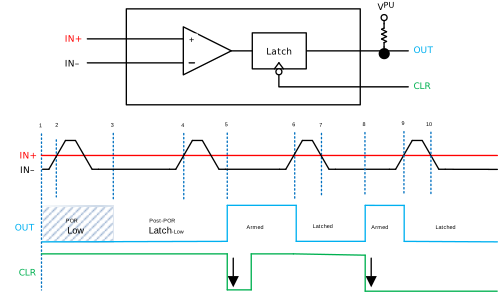
TLV9020L TLV9022L TLV9030L TLV9032L Open Drain Latch Timing Example (L2
                    option)Figure 6-4 Open Drain Latch Timing Example (L2 option)

The following is a summary of the latch operation.

  1. Output is low during the POR period following first power-on.
  2. Input transition is ignored during POR period.
  3. Following the POR period, the OUT stays latched low.
  4. IN- passes IN+, but transition is ignored during latch.
  5. CLR falling edge resets and arms latch awaiting next transition.
  6. IN- > IN+, so OUT goes low and latches.
  7. IN+ > IN–, but OUT remains latched low.
  8. CLR falling edge resets and arms latch for next transition.
  9. IN- crosses IN+, output goes low and latches again.
  10. Output remains latched low even when IN+ > IN–.