SLVSJH7 October   2025 TPS7E67-Q1

ADVANCE INFORMATION  

  1.   1
  2. Features
  3. Applications
  4. Description
  5. Pin Configuration and Functions
  6. Specifications
    1. 5.1 Absolute Maximum Ratings
    2. 5.2 ESD Ratings
    3. 5.3 Recommended Operating Conditions
    4. 5.4 Thermal Information
    5. 5.5 Electrical Characteristics
  7. Detailed Description
    1. 6.1 Overview
    2. 6.2 Functional Block Diagrams
    3. 6.3 Feature Description
      1. 6.3.1 Enable (EN)
      2. 6.3.2 Dropout Voltage
      3. 6.3.3 Power-Good (PG)
      4. 6.3.4 Adjustable Power-Good Delay Timer (DELAY)
      5. 6.3.5 Undervoltage Lockout
      6. 6.3.6 Thermal Shutdown
      7. 6.3.7 Foldback Current Limit
      8. 6.3.8 Power Limit
      9. 6.3.9 Output Pulldown
    4. 6.4 Device Functional Modes
      1. 6.4.1 Device Functional Mode Comparison
      2. 6.4.2 Normal Operation
      3. 6.4.3 Dropout Operation
      4. 6.4.4 Disabled
  8. Application and Implementation
    1. 7.1 Application Information
      1. 7.1.1 Adjustable Device Feedback Resistor Selection
      2. 7.1.2 Recommended Capacitor Types
      3. 7.1.3 Input and Output Capacitor Selection
      4. 7.1.4 Reverse Current
      5. 7.1.5 Feed-Forward Capacitor
      6. 7.1.6 Dropout Voltage
      7. 7.1.7 Estimating Junction Temperature
      8. 7.1.8 Power Dissipation (PD)
      9. 7.1.9 Power Dissipation Versus Ambient Temperature
    2. 7.2 Typical Application
      1. 7.2.1 Design Requirements
      2. 7.2.2 Choose Feedback Resistors
      3. 7.2.3 Setting the Adjustable Power-Good Delay
      4. 7.2.4 Power Supply Recommendations
      5. 7.2.5 Layout
        1. 7.2.5.1 Layout Guidelines
        2. 7.2.5.2 Layout Example
  9. Device and Documentation Support
    1. 8.1 Device Support
      1. 8.1.1 Development Support
      2. 8.1.2 Device Nomenclature
    2. 8.2 Documentation Support
      1. 8.2.1 Related Documentation
    3. 8.3 Receiving Notification of Documentation Updates
    4. 8.4 Support Resources
    5. 8.5 Trademarks
    6. 8.6 Electrostatic Discharge Caution
    7. 8.7 Glossary
  10. Revision History
  11. 10Mechanical, Packaging, and Orderable Information

Package Options

Mechanical Data (Package|Pins)
Thermal pad, mechanical data (Package|Pins)
Orderable Information

Adjustable Power-Good Delay Timer (DELAY)

The power-good delay period is a function of the external capacitor on the DELAY pin. The adjustable delay configures the amount of time required before the PG pin becomes high. This delay is configured by connecting an external capacitor from this pin to GND. Figure 6-3 illustrates the typical timing diagram for the power-good delay pin. If the DELAY pin is left floating, the power-good delay is t(Delay_PG). For more information on how to program the PG delay, see the Section 7.2.3 section.
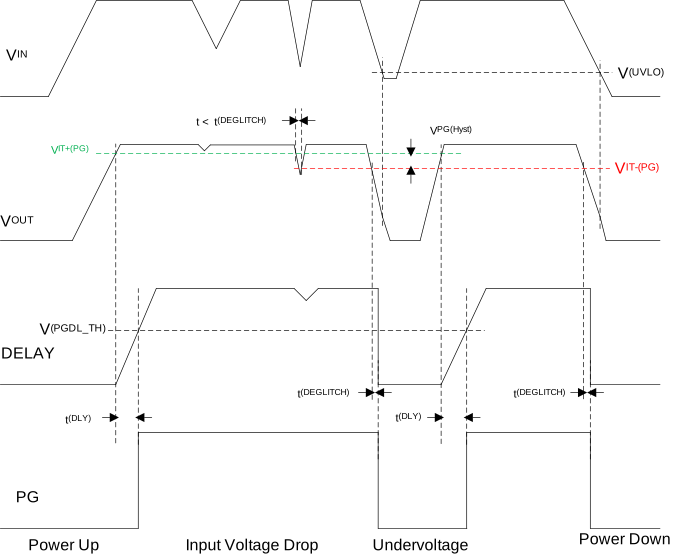
TPS7E67-Q1 Typical
                                        Power-Good Timing Diagram
VPG(Hyst) = VIT+(PG) – VIT–(PG)..
Figure 6-3 Typical Power-Good Timing Diagram