SWRS170L March 2014 – May 2025 WL1807MOD , WL1837MOD
PRODUCTION DATA
- 1
- 1 Features
- 2 Applications
- 3 Description
- 4 Functional Block Diagram
- 5 Device Comparison
- 6 Pin Configuration and Functions
-
7 Specifications
- 7.1 Absolute Maximum Ratings
- 7.2 ESD Ratings
- 7.3 Recommended Operating Conditions
- 7.4 External Digital Slow Clock Requirements
- 7.5 Thermal Resistance Characteristics for MOC 100-Pin Package
- 7.6 WLAN Performance: 2.4GHz Receiver Characteristics
- 7.7 WLAN Performance: 2.4GHz Transmitter Power
- 7.8 WLAN Performance: 5GHz Receiver Characteristics
- 7.9 WLAN Performance: 5GHz Transmitter Power
- 7.10 WLAN Performance: Currents
- 7.11 Bluetooth Performance: BR, EDR Receiver Characteristics—In-Band Signals
- 7.12 Bluetooth Performance: Transmitter, BR
- 7.13 Bluetooth Performance: Transmitter, EDR
- 7.14 Bluetooth Performance: Modulation, BR
- 7.15 Bluetooth Performance: Modulation, EDR
- 7.16 Bluetooth Low Energy Performance: Receiver Characteristics – In-Band Signals
- 7.17 Bluetooth Low Energy Performance: Transmitter Characteristics
- 7.18 Bluetooth Low Energy Performance: Modulation Characteristics
- 7.19 Bluetooth BR and EDR Dynamic Currents
- 7.20 Bluetooth Low Energy Currents
- 7.21
Timing and Switching Characteristics
- 7.21.1 Power Management
- 7.21.2 Power-Up and SHUTDOWN States
- 7.21.3 Chip Top-level Power-Up Sequence
- 7.21.4 WLAN Power-Up Sequence
- 7.21.5 Bluetooth-Bluetooth Low Energy Power-Up Sequence
- 7.21.6 WLAN SDIO Transport Layer
- 7.21.7 HCI UART Shared-Transport Layers for All Functional Blocks (Except WLAN)
- 7.21.8 Bluetooth Codec-PCM (Audio) Timing Specifications
- 8 Detailed Description
- 9 Applications, Implementation, and Layout
- 10Device and Documentation Support
- 11Revision History
- 12Mechanical, Packaging, and Orderable Information
Package Options
Refer to the PDF data sheet for device specific package drawings
Mechanical Data (Package|Pins)
- MOC|100
Thermal pad, mechanical data (Package|Pins)
Orderable Information
7.21.2 Power-Up and SHUTDOWN States
The correct power-up and shutdown sequences must be followed to avoid damage to the device.
While VBAT or VIO or both are deasserted, no signals should be driven to the device. The only exception is the slow clock that is a failsafe I/O.
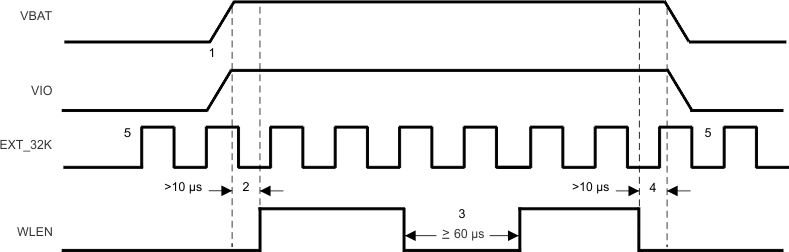
While VBAT, VIO, and slow clock are fed to the device, but WL_EN is deasserted (low), the device is in SHUTDOWN state. In SHUTDOWN state all functional blocks, internal DC-DCs, clocks, and LDOs are disabled.
To perform the correct power-up sequence, assert (high) WL_EN. The internal DC-DCs, LDOs, and clock start to ramp and stabilize. Stable slow clock, VIO, and VBAT are prerequisites to the assertion of one of the enable signals.
To perform the correct shut-down sequence, deassert (low) WL_EN while all the supplies to the device (VBAT, VIO, and slow clock) are still stable and available. The supplies to the chip (VBAT and VIO) can be deasserted only after both enable signals are deasserted (low).
Figure 7-2 shows the general power scheme for the module, including the power-down sequence.