JAJSW71 February   2025 ADC3683-EP , ADC3683-SEP

PRODUCTION DATA  

  1.   1
  2. 特長
  3. アプリケーション
  4. 概要
  5. Pin Configuration and Functions
  6. Specifications
    1. 5.1 Absolute Maximum Ratings
    2. 5.2 ESD Ratings
    3. 5.3 Recommended Operating Conditions
    4. 5.4 Thermal Information
    5. 5.5 Electrical Characteristics - Power Consumption
    6. 5.6 Electrical Characteristics - DC Specifications
    7. 5.7 Electrical Characteristics - AC Specifications
    8. 5.8 Timing Requirements
    9. 5.9 Typical Characteristics - ADC3683
  7. Parameter Measurement Information
  8. Detailed Description
    1. 7.1 Overview
    2. 7.2 Functional Block Diagram
    3. 7.3 Feature Description
      1. 7.3.1 Analog Input
        1. 7.3.1.1 Analog Input Bandwidth
        2. 7.3.1.2 Analog Front End Design
          1. 7.3.1.2.1 Sampling Glitch Filter Design
          2. 7.3.1.2.2 Analog Input Termination and DC Bias
            1. 7.3.1.2.2.1 AC-Coupling
            2. 7.3.1.2.2.2 DC-Coupling
        3. 7.3.1.3 Auto-Zero Feature
      2. 7.3.2 Clock Input
        1. 7.3.2.1 Single Ended vs Differential Clock Input
        2. 7.3.2.2 Signal Acquisition Time Adjust
      3. 7.3.3 Voltage Reference
        1. 7.3.3.1 Internal voltage reference
        2. 7.3.3.2 External voltage reference (VREF)
        3. 7.3.3.3 External voltage reference with internal buffer (REFBUF/CTRL)
      4. 7.3.4 Digital Down Converter
        1. 7.3.4.1 DDC MUX
        2. 7.3.4.2 Digital Filter Operation
        3. 7.3.4.3 FS/4 Mixing with Real Output
        4. 7.3.4.4 Numerically Controlled Oscillator (NCO) and Digital Mixer
        5. 7.3.4.5 Decimation Filter
        6. 7.3.4.6 SYNC
        7. 7.3.4.7 Output Formatting with Decimation
      5. 7.3.5 Digital Data Path and Interface
        1. 7.3.5.1 Data Path Overview
        2. 7.3.5.2 Output Scrambler
        3. 7.3.5.3 Output Bit Mapper
          1. 7.3.5.3.1 2-Wire Mode
          2. 7.3.5.3.2 1-Wire Mode
          3. 7.3.5.3.3 ½-Wire Mode
        4. 7.3.5.4 Device Configuration Steps
          1. 7.3.5.4.1 Configuration Example
        5. 7.3.5.5 Output Data Format
      6. 7.3.6 Test Pattern
    4. 7.4 Device Functional Modes
      1. 7.4.1 Normal Operation
      2. 7.4.2 Power Down Options
      3. 7.4.3 Digital Channel Averaging
    5. 7.5 Programming
      1. 7.5.1 Configuration using PINs only
      2. 7.5.2 Configuration using the SPI interface
        1. 7.5.2.1 Register Write
        2. 7.5.2.2 Register Read
  9. Application Information Disclaimer
    1. 8.1 Application Information
    2. 8.2 Typical Application
      1. 8.2.1 Design Requirements
      2. 8.2.2 Detailed Design Procedure
        1. 8.2.2.1 Input Signal Path
        2. 8.2.2.2 Sampling Clock
        3. 8.2.2.3 Voltage Reference
      3. 8.2.3 Application Curves
    3. 8.3 Initialization Set Up
      1. 8.3.1 Register Initialization During Operation
    4. 8.4 Power Supply Recommendations
    5. 8.5 Layout
      1. 8.5.1 Layout Guidelines
      2. 8.5.2 Layout Example
  10. Register Map
    1. 9.1 Detailed Register Description
  11. 10Device and Documentation Support
    1. 10.1 ドキュメントの更新通知を受け取る方法
    2. 10.2 サポート・リソース
    3. 10.3 Trademarks
    4. 10.4 静電気放電に関する注意事項
    5. 10.5 用語集
  12. 11Revision History
  13. 12Mechanical, Packaging, and Orderable Information
    1. 12.1 Mechanical Data

パッケージ・オプション

デバイスごとのパッケージ図は、PDF版データシートをご参照ください。

メカニカル・データ(パッケージ|ピン)
  • RSB|40
サーマルパッド・メカニカル・データ
発注情報

Output Scrambler

The ADC3683-xEP includes an optional output scrambler feature in 2-wire mode only. The scrambler can enabled by enabling the DSP features (D2 of 0x24) and enabling scrambling (D6 of 0x22). When enabled, each sample is split into two halves. Each half of the samples stream is scrambled independently. For example, if the samples stream is at an 18-bit resolution, the stream is divided into two halves consisting of bits D17-D9 & D8-D0. The two halves are fed into independent scrambling blocks where each input bit (x[k]) of each scrambler is XOR-ed with 2 previous bits (y[k-14] and y[k-15]) as shown in Figure 7-41. Since this is a self-synchronizing scrambler, the start up state of the scrambler is ignored.

ADC3683-SEP ADC3683-EP Scrambler and Descrambler Operation Figure 7-41 Scrambler and Descrambler Operation
Note: The sample streams fed into each scrambler are fed to the scrambler LSB first. Therefore, in the previous example, the sample stream half consisting of D8-D0 is provided to the scrambler with D0 first as x[k] followed by D1 as x[k+1] and so on.

For proper descrambling, the sample stream halves are descrambled independently, then the descrambled data is used to reconstruct the samples. On the receiver side, the incoming serial data stream is descrambled by XOR-ing each incoming bit (y[k]) with 2 previous bits (y[k-14] and y[k-15]).

Note: Since the scramblers are looking at the two halves of the sample stream, the output bit mapper needs to be configured such that each lane contains only one of the sample halves.

For example, in 2-wire and 18-bit mode, by default (Figure 6-1), one lane carries the odd bits (D17, D15, D13, etc.) and one lane carries the even bits (D16, D14, D12, and so on). When scrambling is enabled, the bit mapper needs to be configured so that one lane carries bits D9-D17 and the other lane carries D0-D8 (LSB first for each lane). An example data flow diagram of scrambling an 18-bit sample stream is shown in Figure 7-42, where D17:D0 is the sample provided by the ADC after the resolution select block, the sample is split into D0-D8 and D9-D17 and fed into each scrambler (LSB first) and S0-S17 are the resultant scrambled bits.
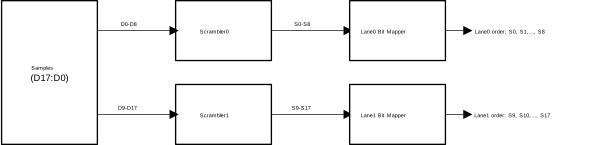
ADC3683-SEP ADC3683-EP 18-bit Scrambling
                    Example Figure 7-42 18-bit Scrambling Example