SLLSFT3 November 2025 MC121-Q1
ADVANCE INFORMATION
- 1
- 1 Features
- 2 Applications
- 3 Description
- 4 Pin Configuration and Functions
- 5 Specifications
-
6 Detailed Description
- 6.1 Overview
- 6.2 Functional Block Diagram
- 6.3 Feature Description
- 6.4 Device Functional Modes
- 6.5 Programming
- 7 Register Map
- 8 Application and Implementation
- 9 Device and Documentation Support
- 10Revision History
6.5.1.1 I2C Read
The I2C read operation begins similarly to a write operation. The controller device sends a START condition on the bus with the 7-bit address of the peripheral device and the R/W bit set to 0b. After the peripheral device responds with an acknowledge signal (ACK), the controller device sends the 8-bit address of the register intended to receive the data. After the peripheral device responds with an ACK signal again, the controller device re-sends the START command, RSTRT, followed by the peripheral address with the R/W bit set to 1b to signify a read operation. The controller device releases the SDA line to receive the register data from the peripheral device. The peripheral responds with an ACK signal to indicate that the peripheral is ready to transmit the register data.
The controller device continues providing a clock signal to the peripheral device. The peripheral device sends the 8-bit register data on the SDA line each clock cycle. At the end of the byte, the controller device sends a negative-acknowledge (NACK) signal, signaling to the peripheral device to stop communications and release the bus. The controller device then sends a STOP condition.
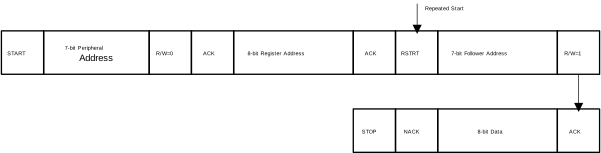 Figure 6-32 I2C Read Sequence