SLLSFT3 November 2025 MC121-Q1
ADVANCE INFORMATION
- 1
- 1 Features
- 2 Applications
- 3 Description
- 4 Pin Configuration and Functions
- 5 Specifications
-
6 Detailed Description
- 6.1 Overview
- 6.2 Functional Block Diagram
- 6.3 Feature Description
- 6.4 Device Functional Modes
- 6.5 Programming
- 7 Register Map
- 8 Application and Implementation
- 9 Device and Documentation Support
- 10Revision History
6.3.1.7 PWM Modulation Modes
The MC121-Q1 provides three PWM modulation modes: synchronous, asynchronous and hybrid. The PWM_MODE bit configures the PWM modulation mode. During synchronous mode, both low-side FETs turn on during the PWM OFF time. Synchronous mode reduces power loss by conducting the freewheeling current through the FET instead of the body diode. However, depending on turn-off current and motor winding inductance, there can be reverse current conduction during synchronous modulation resulting in negative torque and lower motor speed. During asynchronous mode, only one low-side FET remains on during the PWM OFF time while all other FETs are disabled and the freewheeling current is conducted through the body diode of a LS FET. In asynchronous mode, there is no reverse current flow during PWM off time but the power loss can be higher due to body diode conduction. Hybrid combines both modes - synchronous till the freewheeling current drops to < 13mA followed by asynchronous to prevent reverse current flow.
Table 6-1 shows the H-bridge states for the output PWM - H indicates HS FET in given OUTx leg is ON, L indicates LS FET in given OUTx leg is ON, Z indicates both FETs in given OUTx legs are in Hi-Z. The Hall offset signal is the internal signal determined from the Hall sensor state and device settings. The Hall offset signal determines the output switching states in the commutation algorithm state machine. The input PWM duty cycle and commutation mode (square/soft) determine the instantaneous output PWM duty cycle, DOUT.
| Driver State | Description |
Modulation mode set by PWM_MODE |
Hall Offset Signal | OUT1 | OUT2 |
|---|---|---|---|---|---|
| DOUT | PWM ON time/duty cycle | X | L | L | H |
| X | H | H | L | ||
| (1-DOUT), Current Limiting, θDEMAG | Motor current recirculation during PWM OFF time/duty or during current limiting off time, or phase demagnetization before a commutation event | Asynchronous mode | L | L | Z |
| H | Z | L | |||
| Synchronous mode | X | L | L |
Figure 6-19 shows the motor current flow through the H-bridge during PWM ON time, PWM OFF time, and demagnetization states. Refer to Section 6.3.1.6.3 for more details on demagnetization state.
 Figure 6-19 Motor Current and Output
States
Figure 6-19 Motor Current and Output
StatesThe hybrid PWM mode enables both low-side FETs during the PWM OFF time (same as synchronous mode) to avoid recirculating the motor current through the body diode. Once the motor current reaches <13mA, a zero-current detector disables the acceptable low-side FET to place the H-bridge in the asynchronous mode. By automatically switching between synchronous and asynchronous modes, the MC121-Q1 reduces device power loss while avoiding back EMF generating unintended negative current in the motor winding.
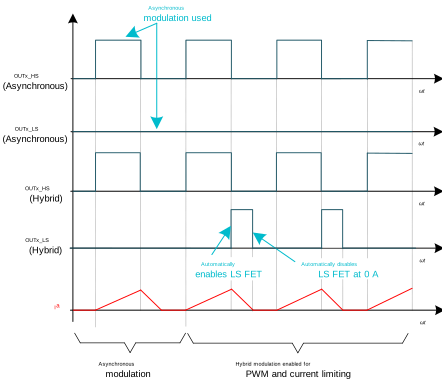 Figure 6-20 Asynchronous and Hybrid
Modulation
Figure 6-20 Asynchronous and Hybrid
Modulation Figure 6-21 Synchronous and Hybrid
Modulation
Figure 6-21 Synchronous and Hybrid
ModulationTable 6-2 shows the settings for the PWM_MODE bitfield to configure the PWM modulation mode.
| PWM_MODE Bits | PWM and Current Limiting OFF Time | Demagnetization State |
|---|---|---|
| 000b | Asynchronous | Asynchronous |
| 001b | Asynchronous | Synchronous |
| 010b | Synchronous | Asynchronous |
| 011b | Synchronous | Synchronous |
| 100b | Synchronous | Hybrid |
| 101b | Asynchronous | Hybrid |
| 110b | Hybrid | Asynchronous |
| 111b | Hybrid | Hybrid |