SLLSFT3 November 2025 MC121-Q1
ADVANCE INFORMATION
- 1
- 1 Features
- 2 Applications
- 3 Description
- 4 Pin Configuration and Functions
- 5 Specifications
-
6 Detailed Description
- 6.1 Overview
- 6.2 Functional Block Diagram
- 6.3 Feature Description
- 6.4 Device Functional Modes
- 6.5 Programming
- 7 Register Map
- 8 Application and Implementation
- 9 Device and Documentation Support
- 10Revision History
6.3.1.6.3 Square Commutation
Square commutation is a simple commutation scheme provided by MC121-Q1 for maximum torque/speed operation. Figure 6-14 shows the driver output voltage relative to the Hall sensor signal in square commutation.
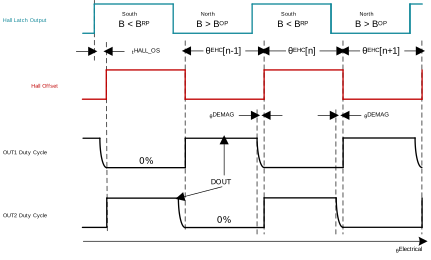 Figure 6-14 Square Commutation Timing Waveform
In square commutation, the output duty cycle remains constant at DOUT with respect to the electrical angle (θElectrical). The signal from the Hall sensor and HALL_INVERT bit determines the OUTx terminal that switches at the commanded duty cycle and the OUTx terminal that is pulled to GND during the 180° electrical half cycle, θEHC.
The demagnetization state, θDEMAG, occurs at the end of the electrical half cycle and is determined by the DEMAG_TIME bits. The purpose of demagnetization is to reduce the motor current to zero and demagnetize the stator windings before reversing the OUTx voltage polarity due to a commutation event. Demagnetization minimizes voltage spikes on the VM supply and OUTx during commutation. Demagnetization also improves efficiency by reducing motor current spikes around the commutation region when back-EMF is minimal. PWM_MODE sets synchronous, asynchronous, or hybrid modulation for motor current during PWM OFF time and θDEMAG time, as described in Section 6.3.1.7. Figure 6-15, Figure 6-16, and Figure 6-17 show timing diagrams for asynchronous, synchronous, and hybrid recirculation states during θDEMAG respectively.
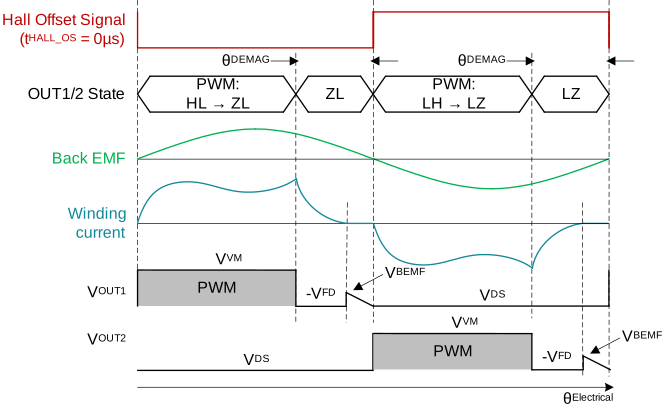 Figure 6-15 Detailed Timing Diagram for Square Commutation Using Asynchronous Mode for
θDEMAG
Figure 6-15 Detailed Timing Diagram for Square Commutation Using Asynchronous Mode for
θDEMAG Figure 6-16 Detailed Timing Diagram for Square Commutation Using Synchronous Mode for
θDEMAG
Figure 6-16 Detailed Timing Diagram for Square Commutation Using Synchronous Mode for
θDEMAG Figure 6-17 Detailed Timing Diagram for Square Commutation Using Hybrid Mode for
θDEMAG
Figure 6-17 Detailed Timing Diagram for Square Commutation Using Hybrid Mode for
θDEMAGThe demag time (DEMAG_TIME) can be set to a fixed time or can be automatically determined. When the AUTO_DEMAG_EN is set to 0x0, the demagnatization time is constant across operating conditions, and the DEMAG_TIME bits determine the θDEMAG based on speed of the motor. When the AUTO_DEMAG_EN is set to 0x1, the driver automatically adjusts the θDEMAG angle to optimize the demagnetization duration based on the speed of the motor.