SLOU590 January   2025 TAS5802 , TAS5815


  1.   1
  2.   Abstract
  3.   Trademarks
  4. 1General Overview
    1. 1.1 Supported Use Cases
  5. 2Process Flows
    1. 2.1  Overview
    2. 2.2  Process Flow 1
      1. 2.2.1  SRC
      2. 2.2.2  Input Mixer
      3. 2.2.3  Equalizer
      4. 2.2.4  Volume
      5. 2.2.5  DPEQ
      6. 2.2.6  2-Band DRC
      7. 2.2.7  AGL
      8. 2.2.8  Clipper
      9. 2.2.9  Output Crossbar
      10. 2.2.10 DSP Memory Map
    3. 2.3  Process Flow 2
      1. 2.3.1  SRC
      2. 2.3.2  Input Mixer
      3. 2.3.3  Equalizer
      4. 2.3.4  Volume
      5. 2.3.5  DPEQ
      6. 2.3.6  3-Band DRC
      7. 2.3.7  AGL
      8. 2.3.8  Clipper
      9. 2.3.9  Output Crossbar
      10. 2.3.10 DSP Memory Map
    4. 2.4  Process Flow 3
      1. 2.4.1 SRC
      2. 2.4.2 Input Mixer
      3. 2.4.3 Equalizer
      4. 2.4.4 Volume
      5. 2.4.5 DPEQ
      6. 2.4.6 2-Band DRC
      7. 2.4.7 Clipper
      8. 2.4.8 Output Crossbar
      9. 2.4.9 DSP Memory Map
    5. 2.5  Process Flow 4
      1. 2.5.1 SRC
      2. 2.5.2 Input Mixer
      3. 2.5.3 Equalizer
      4. 2.5.4 Volume
      5. 2.5.5 DPEQ
      6. 2.5.6 3-Band DRC
      7. 2.5.7 Clipper
      8. 2.5.8 Output Crossbar
      9. 2.5.9 DSP Memory Map
    6. 2.6  Process Flow 5
      1. 2.6.1  SRC
      2. 2.6.2  Input Mixer
      3. 2.6.3  Equalizer
      4. 2.6.4  Volume
      5. 2.6.5  DPEQ
      6. 2.6.6  2-Band DRC
      7. 2.6.7  AGL
      8. 2.6.8  Clipper
      9. 2.6.9  Output Crossbar
      10. 2.6.10 DSP Memory Map
    7. 2.7  Process Flow 6
      1. 2.7.1  SRC
      2. 2.7.2  Input Mixer
      3. 2.7.3  Equalizer
      4. 2.7.4  Volume
      5. 2.7.5  DPEQ
      6. 2.7.6  3-Band DRC
      7. 2.7.7  AGL
      8. 2.7.8  Clipper
      9. 2.7.9  Output Crossbar
      10. 2.7.10 DSP Memory Map
    8. 2.8  Process Flow 7
      1. 2.8.1 SRC
      2. 2.8.2 Input Mixer
      3. 2.8.3 Equalizer
      4. 2.8.4 Volume
      5. 2.8.5 DPEQ
      6. 2.8.6 2-Band DRC
      7. 2.8.7 Clipper
      8. 2.8.8 Output Crossbar
      9. 2.8.9 DSP Memory Map
    9. 2.9  Process Flow 8
      1. 2.9.1  SRC
      2. 2.9.2  Input Mixer
      3. 2.9.3  Equalizer
      4. 2.9.4  Volume
      5. 2.9.5  DPEQ
      6. 2.9.6  3-Band DRC
      7. 2.9.7  Clipper
      8. 2.9.8  Output Crossbar
      9. 2.9.9  DPEQ
      10. 2.9.10 DSP Memory Map
    10. 2.10 Process Flow 9
      1. 2.10.1  SRC
      2. 2.10.2  Input Mixer
      3. 2.10.3  Equalizer
      4. 2.10.4  Volume
      5. 2.10.5  DPEQ
      6. 2.10.6  2-Band DRC
      7. 2.10.7  AGL
      8. 2.10.8  Clipper
      9. 2.10.9  Output Crossbar
      10. 2.10.10 DSP Memory Map
  6. 3Audio Processing Blocks
    1. 3.1 Input Mixer
    2. 3.2 Equalizer
    3. 3.3 Volume
    4. 3.4 DPEQ
      1. 3.4.1 DPEQ
      2. 3.4.2 Energy Sense
      3. 3.4.3 Low Level EQ
      4. 3.4.4 High Level EQ
    5. 3.5 3-Band DRC
      1. 3.5.1 DRC Time Constant
      2. 3.5.2 Crossover
    6. 3.6 2-Band DRC
      1. 3.6.1 DRC Time Constant
      2. 3.6.2 Crossover
    7. 3.7 AGL
    8. 3.8 Clipper
    9. 3.9 Output Crossbar
  7.   A Appendix
    1.     A.1 DSP Memory Map for Process Flow 1, 3, 5 and 7
    2.     A.2 DSP Memory Map for Process Flow 2, 4, 6 and 8
    3.     A.3 DSP Memory Map for Process 9

AGL

The Automatic Gain Limiter (AGL) is a feedback mechanism that can be used to automatically control the audio signal amplitude or dynamic range within specified limits. The automatic gain limiting is done by sensing the audio signal level using an alpha filter energy structure at the output of the AGL then adjusting the gain based on whether the signal level is above or below the defined threshold. Three decisions made by the AGL are engage, disengage, or do nothing. The rate at which the AGL engages or disengages depends on the attack and release settings respectively.

Figure 3-16 shows the AGL Tuning Window. By default, the AGL is disabled and can be enabled by clicking the ON/OFF switch on the top right corner.

 AGL Tuning WindowFigure 3-16 AGL Tuning Window
    Threshold (db)This parameter sets the threshold at which the compressor is activated. Lowering the threshold causes the compression to be activated at lower volume levels. Once the signal exceeds this threshold, compression is applied.
    Alpha (ms)This parameter configures the sharpness of the compression knee of the AGL.
    Attack Rate (0 – 1)This parameter controls how quickly compression is applied to the signal. Higher values causes the compressor to respond to signals quickly, while lower values decrease the response time.
    Release Rate (0 – 1)This parameter controls how quickly compression is removed from the signal as the signal gets quieter. Higher values cause the compressor to release from signals quickly, while lower values decrease the release time.
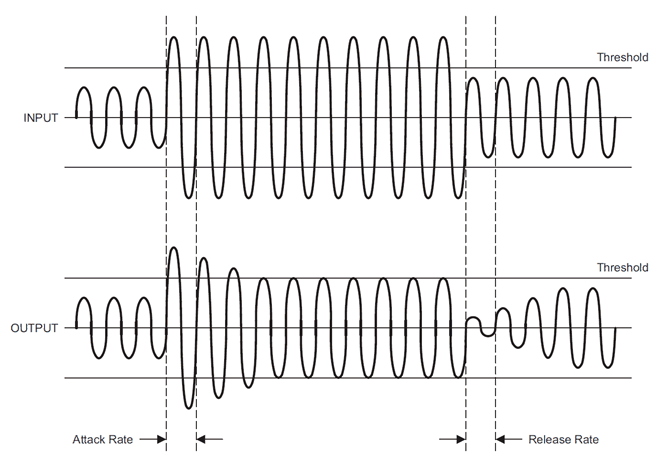
 AGL Attack and ReleaseFigure 3-17 AGL Attack and Release