DLPA059H January 2015 – April 2024 DLP160AP , DLP160CP , DLP2000 , DLP2010 , DLP230NP , DLP3010 , DLP3310 , DLP470NE , DLP470TE , DLP4710 , DLP471NE , DLP471TE , DLP471TP , DLP472NE , DLP472TE , DLP480RE , DLP550HE , DLP550JE , DLP650LE , DLP650NE , DLP650TE , DLP651LE , DLP651NE , DLP660TE , DLP670RE , DLP780NE , DLP780TE , DLP781NE , DLP781TE , DLP800RE , DLP801RE , DLP801XE , DLPA1000 , DLPA2000 , DLPA2005 , DLPA3000 , DLPA3005 , DLPC2607 , DLPC3420 , DLPC3421 , DLPC3430 , DLPC3433 , DLPC3435 , DLPC3438 , DLPC3439 , DLPC6401 , DLPC6540
- 1
- Abstract
- Trademarks
- 1 Introduction
- 2 DLP Display Projection Benefits
- 3 What is DLP Technology?
- 4 The DLP Display System
- 5 Selecting the Correct DLP Display Chipset
- 6 How to Evaluate Selected DLP Display Chipset
- 7 Selecting the Correct Optical Engine
- 8 DLP Products Supply Chain
- 9 Development and Manufacturing
- 10Online Resources
- 11Common Display and Projection Terminology
- 12References
- 13Revision History
6 How to Evaluate Selected DLP Display Chipset
After selecting the right chipset for your application, you can purchase a DLP Display LightCrafter™ evaluation module (EVM). The EVM has a few key features that will help you finalize your chipset and brightness level selection, and software configuration settings.
- Image quality assessment. The tool provides you with an optical module at a specified brightness level. Keep in mind that you may find projectors in the market that advertise a specific brightness; you should measure the brightness of those projectors yourself to verify the measurement of each individual product.
- Modifying chipset software parameters. Most of the EVMs can be used with a PC Windows software package to make display changes including test patterns/images, color temperature, keystone, DLP IntelliBright™ algorithms, and RGB LED current modifications. The PC tool can also update the firmware of the EVM.
Figure 6-1 shows an example screen capture.
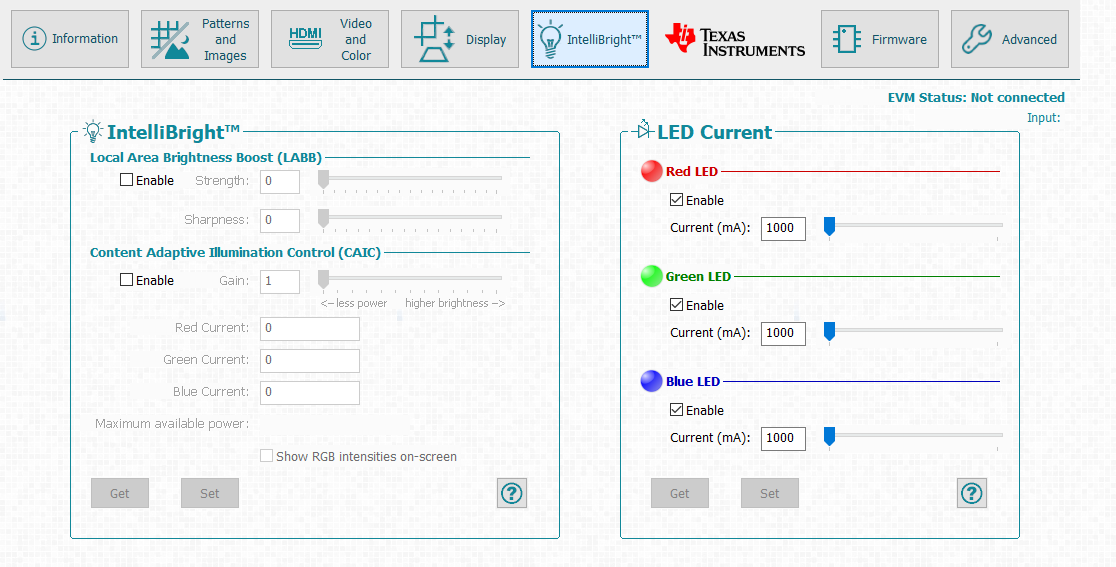 Figure 6-1 .33 1080p (DLP3310) EVM PC
Tool DLP IntelliBright Algorithms Screen
Figure 6-1 .33 1080p (DLP3310) EVM PC
Tool DLP IntelliBright Algorithms ScreenIn a few cases, the EVM can connect to a single board computer (SBC) to enable customization of the display instead of using a PC software. This is the case for the .2nHD (DLP2000) and the .23 1080p (DLP230NP) DLP Pico chipsets.
- I2C communication. In all cases, I2C is used to command/control the chipset to enable various software features documented with the chipset’s software users guide. I2C communication can be done directly with all EVMs. However, each EVM has its unique requirements on how to do so.
- DLP Pico Firmware selector. For DLP Pico products, you can download a broad selection of firmware options that will vary depending on the chipset, PMIC, display controller pin-mapping, and application profile.
- Optical module options. You may want to look at various optical module choices for a specific chipset offering including different levels of brightness, throw ratio, contrast, and optics design. Our optical module search tool allows you to choose from many optical modules available in the market today. You can contact the optical module maker to learn more about the module. Seldom a production optical modules can be connected directly to a DLP EVM. The optical module manufacturer may need to offer you with their own evaluation tool or instructions how to connect to the TI EVM. Notice the EVM comes rated for a specific LED current drive, which needs to match with the desired optical module.