SLAAES9 March 2025 MSP430FR5043 , MSP430FR6005 , MSP430FR6007 , MSP430FR6043 , MSP430FR6045 , MSP430FR6047
2 Flow Meter Measurement Theory
The ultrasonic flow meter design is based on the principle of ToF measurement. This measurement refers to the time a signal takes to travel from a transmitting transducer to a receiving transducer. Figure 2-1 shows a typical flow pipe.
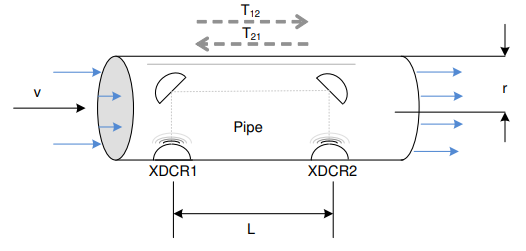 Figure 2-1 Typical Flow Pipe
The propagation time of a signal traveling from the first transducer to the second transducer is given by T12. T21 represents the propagation time in the opposite direction. Calculate these timings according to the following equations as a function of the velocity of the ultrasound in gas and the velocity of gas flow. Because this length is much larger than the radius of the pipe, r, the propagation length of the wave that is perpendicular to the flow is considered to be negligible in the following analysis.
where:
- c is the velocity of the ultrasound in the medium.
- v is the velocity of gas flow.
- L is the propagation length of the pipe along the flow of gas.
Use Equation 1 through Equation 3 to derive the velocity of gas flow (v), which is possible even without knowing the velocity of the ultrasound in the medium (c). This reference design calculates gas flow assuming that the velocity of the ultrasound is unknown. In this case, derive Equation 4 from Equation 1 and Equation 2 by eliminating c.