SLVAG13 April 2025
- 1
- Abstract
- Trademarks
- 1Introduction
- 2DC vs. AC Power Grids: A Comparative Overview
- 3DC Microgrids Across Industries
-
4TI Solutions for DC Applications
- 4.1 10kW GaN-Based Single-Phase String Inverter with Battery Energy Storage System
- 4.2 Bidirectional, Dual Active Bridge Reference Design for Level 3 Electric Vehicle Charging Stations
- 4.3 11-kW, Bidirectional Three-Phase Three-Level (T-Type) Inverter and PFC Reference Design
- 4.4 300V-1,000V Input 48W Isolated Auxiliary Power Reference Design with Low Standby Power
- 4.5 AFE for Insulation Monitoring in High-Voltage EV Charging and Solar Energy Reference Design
- 5Conclusion
- 6Reference
4.3 11-kW, Bidirectional Three-Phase Three-Level (T-Type) Inverter and PFC Reference Design
Connecting the DC microgrid to the AC grid requires a bidirectional power supply. This supply handles AC-to-DC conversion with a high power factor and must be able to perform DC-to-AC conversion as an inverter. Because of the power levels, efficiency as well as thermal management are of top concern.
TI’s bidirectional three-phase reference design, shown in Figure 4-3 and Figure 4-4, has a 11kW bidirectional inverter and PFC stage that can handle 600V to 900V on the DC bus, as well as three-phase 400VAC from the grid.
 Figure 4-3 Bidirectional Three-Phase Reference Design Board Photo and Block Diagram
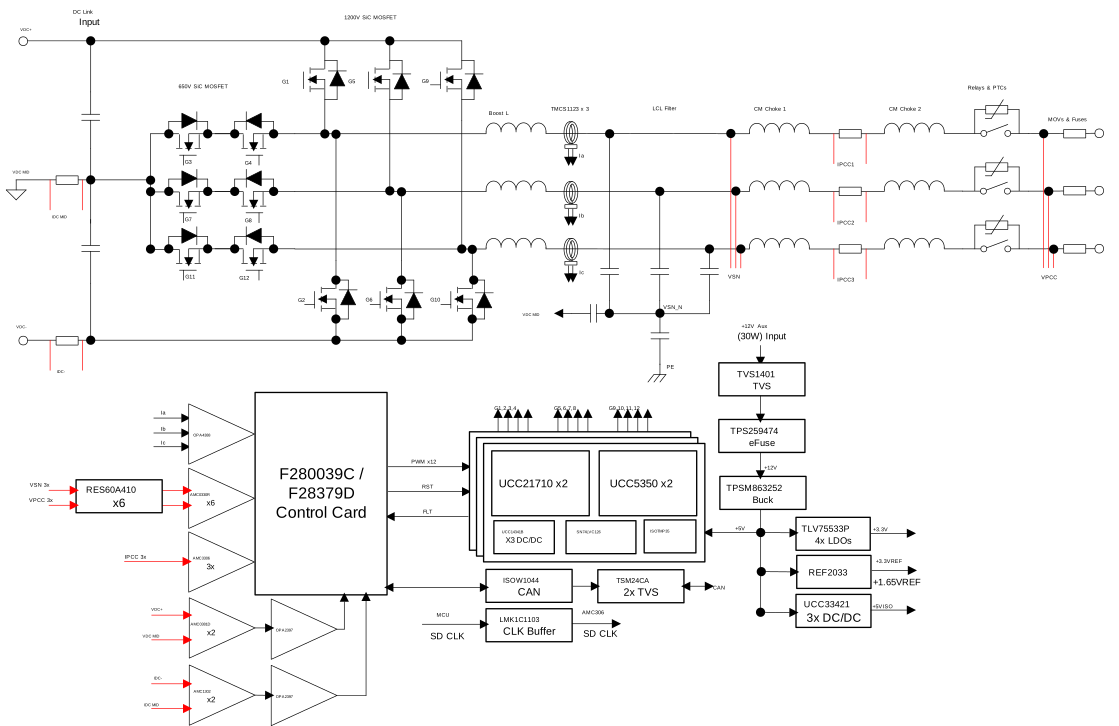 Figure 4-4 Bidirectional Three-Phase Reference Design Block Diagram
The full reference design consists of two separate boards. The main board has all the switching devices, an LCL (inductor-capacitor-inductor) filter, sensing electronics and power structures. The second board hosts the control circuitry, based on a C2000™ digital signal processor control card. The complete design achieves a peak efficiency of 98.6% and has a power density of 2.2kW/L.