SLYT863 April 2025 LM5066I
- 1
- 1 Introduction
- 2 3
- 3 Challenges in designing a hot-swap circuit for a 48V AI server
- 4 Challenge No. 1: Turnoff delay during an output short-circuit
- 5 Challenge No. 2: False gate turn-off during a load transient
- 6 Challenge No. 3: Parallel resonance during controlled (slow) turn-on
- 7 Proposed circuit enhancements
- 8 Improving the turn-off response
- 9 Overcoming false turn-off for dynamic loads
- 10Damping parasitic oscillations
- 11Design guidelines and component selection
- 12Cdv/dt discharge circuit
- 13Conclusion
- 14References
- 15Related Websites
1 Introduction
With advancements in artificial intelligence (AI) and machine learning, enterprise servers have become extremely power-hungry as they simultaneously process a large amount of data and storage. The steady-state power rating of each server motherboard has gone up to 5kW or 6kW, in contrast to 1kW or 2 kW for general servers. The form factor remains the same, however, which imposes system design challenges given the increased power density. The load amplitude, slew rate and frequency of transient loads on AI servers have increased three to four times compared to general servers.
Figure 1 shows a typical power distribution in a 48V rack server where the input is protected by the hot-swap circuit - and then distributed to all downstream system loads.
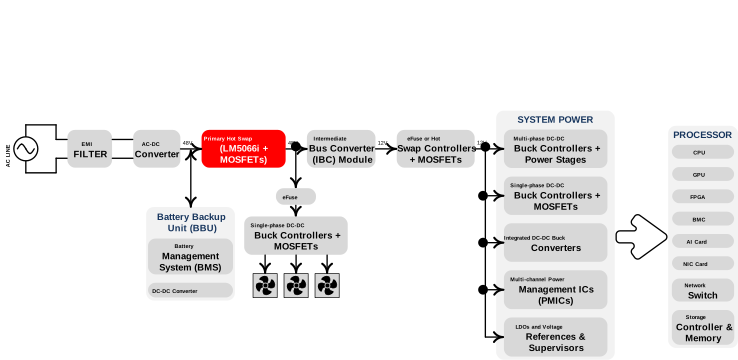 Figure 1 Typical block diagram of a 48V
rack server power distribution.
Figure 1 Typical block diagram of a 48V
rack server power distribution.