SNLU237B September 2018 – July 2025
- 1
- Description
- Features
- 4
- 1Evaluation Module Overview
-
2Hardware
- 2.1 Board Setup Details
- 2.2
Configuration Options
- 2.2.1
Bootstrap Options
- 2.2.1.1 Straps for PHY Address
- 2.2.1.2 Strap for DP83869 Functional Mode Selection
- 2.2.1.3 Straps for RGMII/SGMII to Copper
- 2.2.1.4 Straps for RGMII to 1000Base-X
- 2.2.1.5 Straps for RGMII to 100Base-FX
- 2.2.1.6 Straps for Bridge Mode (SGMII-RGMII)
- 2.2.1.7 Straps for 100 M Media Converter
- 2.2.1.8 Straps for 1000 M Media Convertor
- 2.2.2 SGMII/Fiber Interface
- 2.2.3 RGMII
- 2.2.4 Clock Output
- 2.2.5 Clock Input
- 2.2.6 Switch Configuration Options
- 2.2.1
Bootstrap Options
- 3Software
- 4Hardware Design Files
- 5Additional Information
- 6Revision History
2.2.5 Clock Input
The EVM is configured for default crystal input clock operation. The EVM supports the option to provide clock from 25-MHz crystal, 25-MHz CMOS oscillator, and the External clock from the SMB connector. A 50-Ω Coax cable with a SMB connector needs to be used for providing clock input from external sources.
 Figure 2-2 Onboard Clock
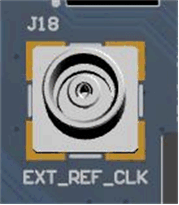 Figure 2-3 External Clock Input