SPRSPA1B March 2025 – November 2025 AM62L
PRODUCTION DATA
- 1
- 1 Features
- 2 Applications
- 3 Description
- 4 Device Comparison
-
5 Terminal Configuration and Functions
- 5.1 Pin Diagrams
- 5.2 Pin Attributes
- 5.3
Signal Descriptions
- 14
- 5.3.1 ADC
- 5.3.2 CPSW3G
- 5.3.3 CPTS
- 5.3.4 DDRSS
- 5.3.5 DSI
- 5.3.6 DSS
- 5.3.7 ECAP
- 5.3.8 Emulation and Debug
- 5.3.9 EPWM
- 5.3.10 EQEP
- 5.3.11 GPIO
- 5.3.12 GPMC
- 5.3.13 I2C
- 5.3.14 MCAN
- 5.3.15 MCASP
- 5.3.16 MCSPI
- 5.3.17 MDIO
- 5.3.18 MMC
- 5.3.19 OSPI
- 5.3.20 Power Supply
- 5.3.21 Reserved
- 5.3.22 System and Miscellaneous
- 5.3.23 TIMER
- 5.3.24 UART
- 5.3.25 USB
- 5.4 Pin Connectivity Requirements
-
6 Specifications
- 6.1 Absolute Maximum Ratings
- 6.2 ESD Ratings
- 6.3 Power-On Hours (POH)
- 6.4 Recommended Operating Conditions
- 6.5 Operating Performance Points
- 6.6 Power Consumption Summary
- 6.7
Electrical
Characteristics
- 6.7.1 I2C Open-Drain, and Fail-Safe (I2C OD FS) Electrical Characteristics
- 6.7.2 Fail-Safe Reset (FS RESET) Electrical Characteristics
- 6.7.3 High-Frequency Oscillator (HFOSC) Electrical Characteristics
- 6.7.4 Low-Frequency Oscillator (LFXOSC) Electrical Characteristics
- 6.7.5 SDIO Electrical Characteristics
- 6.7.6 LVCMOS Electrical Characteristics
- 6.7.7 1P8-LVCMOS Electrical Characteristics
- 6.7.8 RTC-LVCMOS Electrical Characteristics
- 6.7.9 ADC Electrical Characteristics
- 6.7.10 DSI (D-PHY) Electrical Characteristics
- 6.7.11 USB2PHY Electrical Characteristics
- 6.7.12 DDR Electrical Characteristics
- 6.8 VPP Specifications for One-Time Programmable (OTP) eFuses
- 6.9 Thermal Resistance Characteristics
- 6.10 Temperature Sensor Characteristics
- 6.11
Timing and Switching Characteristics
- 6.11.1 Timing Parameters and Information
- 6.11.2 Power Supply Requirements
- 6.11.3 System Timing
- 6.11.4 Clock Specifications
- 6.11.5
Peripherals
- 6.11.5.1 CPSW3G
- 6.11.5.2 CPTS
- 6.11.5.3 DDRSS
- 6.11.5.4 DSI
- 6.11.5.5 DSS
- 6.11.5.6 ECAP
- 6.11.5.7 Emulation and Debug
- 6.11.5.8 EPWM
- 6.11.5.9 EQEP
- 6.11.5.10 GPIO
- 6.11.5.11 GPMC
- 6.11.5.12 I2C
- 6.11.5.13 MCAN
- 6.11.5.14 MCASP
- 6.11.5.15 MCSPI
- 6.11.5.16
MMCSD
- 6.11.5.16.1
MMC0 - eMMC/SD/SDIO Interface
- 6.11.5.16.1.1 Legacy SDR Mode
- 6.11.5.16.1.2 High Speed SDR Mode
- 6.11.5.16.1.3 High Speed DDR Mode
- 6.11.5.16.1.4 HS200 Mode
- 6.11.5.16.1.5 Default Speed Mode
- 6.11.5.16.1.6 High Speed Mode
- 6.11.5.16.1.7 UHS–I SDR12 Mode
- 6.11.5.16.1.8 UHS–I SDR25 Mode
- 6.11.5.16.1.9 UHS–I SDR50 Mode
- 6.11.5.16.1.10 UHS–I DDR50 Mode
- 6.11.5.16.1.11 UHS–I SDR104 Mode
- 6.11.5.16.2 MMC1/MMC2 - SD/SDIO Interface
- 6.11.5.16.1
MMC0 - eMMC/SD/SDIO Interface
- 6.11.5.17 OSPI
- 6.11.5.18 Timers
- 6.11.5.19 UART
- 6.11.5.20 USB
-
7 Detailed Description
- 7.1 Overview
- 7.2 Processor Subsystem
- 7.3 Other Subsystem
- 7.4
Peripherals
- 7.4.1 ADC
- 7.4.2 Gigabit Ethernet Switch (CPSW3G)
- 7.4.3 DDR Subsystem (DDRSS)
- 7.4.4 Display Subsystem (DSS)
- 7.4.5 Enhanced Capture (ECAP)
- 7.4.6 Error Location Module (ELM)
- 7.4.7 Enhanced Pulse Width Modulation (EPWM)
- 7.4.8 Enhanced Quadrature Encoder Pulse (EQEP)
- 7.4.9 General-Purpose Interface (GPIO)
- 7.4.10 General-Purpose Memory Controller (GPMC)
- 7.4.11 Global Timebase Counter (GTC)
- 7.4.12 Inter-Integrated Circuit (I2C)
- 7.4.13 Modular Controller Area Network (MCAN)
- 7.4.14 Multichannel Audio Serial Port (MCASP)
- 7.4.15 Multichannel Serial Peripheral Interface (MCSPI)
- 7.4.16 Multi-Media Card Secure Digital (MMCSD)
- 7.4.17 Octal Serial Peripheral Interface (OSPI)
- 7.4.18 Timers
- 7.4.19 Real-Time Clock (RTC)
- 7.4.20 Universal Asynchronous Receiver/Transmitter (UART)
- 7.4.21 Universal Serial Bus Subsystem (USBSS)
-
8 Applications, Implementation, and Layout
- 8.1 Device Connection and Layout Fundamentals
- 8.2 Peripheral- and Interface-Specific Design Information
- 8.3 Clock Routing Guidelines
- 9 Device and Documentation Support
- Revision History
- 10Mechanical, Packaging, and Orderable Information
6.11.5.11.1 GPMC and NOR Flash — Synchronous Mode
Table 6-61 and Table 6-62 present timing requirements and switching characteristics for GPMC and NOR Flash - Synchronous Mode.
Table 6-61 GPMC and NOR Flash Timing Requirements — Synchronous Mode see Figure 6-50, Figure 6-51, and Figure 6-54
| NO. | PARAMETER | DESCRIPTION | MIN | MAX | UNIT |
|---|---|---|---|---|---|
| F12 | tsu(dV-clkH) | Setup time, GPMC_AD[15:0] valid before GPMC_CLK high | 0.92 | ns | |
| F13 | th(clkH-dV) | Hold time, GPMC_AD[15:0] valid after GPMC_CLK high | 2.09 | ns | |
| F21 | tsu(waitV-clkH) | Setup time, GPMC_WAIT[j](1)(2) valid before GPMC_CLK high | 0.92 | ns | |
| F22 | th(clkH-waitV) | Hold time, GPMC_WAIT[j](1)(2) valid after GPMC_CLK high | 2.09 | ns |
(1) In
GPMC_WAIT[j], j is equal to 0 or 1.
(2) Wait
monitoring support is limited to a WaitMonitoringTime value > 0. For a full
description of wait monitoring feature, see General-Purpose Memory Controller
(GPMC) section in the device TRM.
Table 6-62 GPMC and NOR Flash Switching Characteristics – Synchronous Mode see Figure 6-50,
Figure 6-51, Figure 6-52, Figure 6-53, and Figure 6-54
| NO. | PARAMETER | DESCRIPTION | MIN | MAX | UNIT |
|---|---|---|---|---|---|
| F0 | tc(clk) | Cycle time, GPMC_CLK(16) | 7.52 | ns | |
| F1 | tw(clkH) | Typical pulse duration, GPMC_CLK high | 0.475P(13) - 0.3 | ns | |
| F1 | tw(clkL) | Typical pulse duration, GPMC_CLK low | 0.475P(13) - 0.3 | ns | |
| F2 | td(clkH-csnV) | Delay time, GPMC_CLK rising edge to GPMC_CSn[i] transition(12) | F(5) - 2.2 | F(5) + 3.75 | ns |
| F3 | td(clkH-CSn[i]V) | Delay time, GPMC_CLK rising edge to GPMC_CSn[i] invalid(12) | D(4) - 2.2 | D(4) + 4.5 | ns |
| F4 | td(aV-clk) | Delay time, GPMC_A[27:1] valid to GPMC_CLK first edge | B(2) - 2.3 | B(2) + 4.5 | ns |
| F5 | td(clkH-aIV) | Delay time, GPMC_CLK rising edge to GPMC_A[27:1] invalid | -2.3 | 4.5 | ns |
| F6 | td(be[x]nV-clk) | Delay time, GPMC_BE0n_CLE, GPMC_BE1n valid to GPMC_CLK first edge | B(2) - 2.3 | B(2) + 1.9 | ns |
| F7 | td(clkH-be[x]nIV) | Delay time, GPMC_CLK rising edge to GPMC_BE0n_CLE, GPMC_BE1n invalid | D(4) - 2.3 | D(4) + 1.9 | ns |
| F8 | td(clkH-advn) | Delay time, GPMC_CLK rising edge to GPMC_ADVn_ALE transition | G(6) - 2.3 | G(6) + 4.5 | ns |
| F9 | td(clkH-advnIV) | Delay time, GPMC_CLK rising edge to GPMC_ADVn_ALE invalid | D(4) - 2.3 | D(4) + 4.5 | ns |
| F10 | td(clkH-oen) | Delay time, GPMC_CLK rising edge to GPMC_OEn_REn transition | H(7) - 2.3 | H(7) + 3.5 | ns |
| F11 | td(clkH-oenIV) | Delay time, GPMC_CLK rising edge to GPMC_OEn_REn invalid | D(4) - 2.3 | D(4) + 3.5 | ns |
| F14 | td(clkH-wen) | Delay time, GPMC_CLK rising edge to GPMC_WEn transition | I(8) - 2.3 | I(8) + 4.5 | ns |
| F15 | td(clkH-do) | Delay time, GPMC_CLK rising edge to GPMC_AD[15:0] transition(9) | - 2.3 | + 2.7 | ns |
| F15 | td(clkL-do) | Delay time, GPMC_CLK falling edge to GPMC_AD[15:0] data bus transition(10) | - 2.3 | + 2.7 | ns |
| F15 | td(clkL-do). | Delay time, GPMC_CLK falling edge to GPMC_AD[15:0] data bus transition(11) | - 2.3 | + 2.7 | ns |
| F17 | td(clkH-be[x]n) | Delay time, GPMC_CLK rising edge to GPMC_BE0n_CLE, GPMC_BE1n transition(9) | - 2.3 | + 1.9 | ns |
| F17 | td(clkL-be[x]n) | Delay time, GPMC_CLK falling edge to GPMC_BE0n_CLE, GPMC_BE1n transition(10) | - 2.3 | + 1.9 | ns |
| F17 | td(clkL-be[x]n). | Delay time, GPMC_CLK falling edge to GPMC_BE0n_CLE, GPMC_BE1n transition(11) | - 2.3 | + 1.9 | ns |
| F18 | tw(csnV) | Pulse duration, GPMC_CSn[i](12) low | A(1) | ns | |
| F19 | tw(be[x]nV) | Pulse duration, GPMC_BE0n_CLE, GPMC_BE1n low | C(3) | ns | |
| F20 | tw(advnV) | Pulse duration, GPMC_ADVn_ALE low | K(14) | ns |
(1) For
single read: A = (CSRdOffTime - CSOnTime) × (TimeParaGranularity + 1) ×
GPMC_FCLK(15)
For single write: A = (CSWrOffTime - CSOnTime) × (TimeParaGranularity + 1) × GPMC_FCLK(15)
For burst read: A = (CSRdOffTime - CSOnTime + (n - 1) × PageBurstAccessTime) × (TimeParaGranularity + 1) × GPMC_FCLK(15)
For burst write: A = (CSWrOffTime - CSOnTime + (n - 1) × PageBurstAccessTime) × (TimeParaGranularity + 1) × GPMC_FCLK(15)
With n being the page burst access number.
For single write: A = (CSWrOffTime - CSOnTime) × (TimeParaGranularity + 1) × GPMC_FCLK(15)
For burst read: A = (CSRdOffTime - CSOnTime + (n - 1) × PageBurstAccessTime) × (TimeParaGranularity + 1) × GPMC_FCLK(15)
For burst write: A = (CSWrOffTime - CSOnTime + (n - 1) × PageBurstAccessTime) × (TimeParaGranularity + 1) × GPMC_FCLK(15)
With n being the page burst access number.
(2) Address bus / Byte Enables become valid at start of cycle, GPMC_CLK activation
time may be delayed after start of cycle B = ClkActivationTime ×
GPMC_FCLK(15)
(3) For
single read: C = RdCycleTime × (TimeParaGranularity + 1) × GPMC_FCLK(15)
For single write: C = WrCycleTime × (TimeParaGranularity + 1) × GPMC_FCLK(15)
For burst read: C = (RdCycleTime + (n - 1) × PageBurstAccessTime) × (TimeParaGranularity + 1) × GPMC_FCLK(15)
For burst write: C = (WrCycleTime + (n - 1) × PageBurstAccessTime) × (TimeParaGranularity + 1) × GPMC_FCLK(15)
With n being the page burst access number.
For single write: C = WrCycleTime × (TimeParaGranularity + 1) × GPMC_FCLK(15)
For burst read: C = (RdCycleTime + (n - 1) × PageBurstAccessTime) × (TimeParaGranularity + 1) × GPMC_FCLK(15)
For burst write: C = (WrCycleTime + (n - 1) × PageBurstAccessTime) × (TimeParaGranularity + 1) × GPMC_FCLK(15)
With n being the page burst access number.
(4) For
single read: D = (RdCycleTime - RdAccessTime) × (TimeParaGranularity + 1) ×
GPMC_FCLK(15)
For single write: D = (WrCycleTime - WrAccessTime) × (TimeParaGranularity + 1) × GPMC_FCLK(15)
For burst read: D = (RdCycleTime - RdAccessTime + (n - 1) × PageBurstAccessTime) × (TimeParaGranularity + 1) × GPMC_FCLK(15)
For burst write: D = (WrCycleTime - WrAccessTime + (n - 1) × PageBurstAccessTime) × (TimeParaGranularity + 1) × GPMC_FCLK(15)
With n being the page burst access number.
For single write: D = (WrCycleTime - WrAccessTime) × (TimeParaGranularity + 1) × GPMC_FCLK(15)
For burst read: D = (RdCycleTime - RdAccessTime + (n - 1) × PageBurstAccessTime) × (TimeParaGranularity + 1) × GPMC_FCLK(15)
For burst write: D = (WrCycleTime - WrAccessTime + (n - 1) × PageBurstAccessTime) × (TimeParaGranularity + 1) × GPMC_FCLK(15)
With n being the page burst access number.
(5) For
CSn falling edge (CS activated):
For CSn rising edge (CS deactivated) in Reading mode:
For CSn rising edge (CS deactivated) in Writing mode:
- Case GPMCFCLKDIVIDER = 0:
- F = 0.5 × CSExtraDelay × GPMC_FCLK(15)
- Case GPMCFCLKDIVIDER = 1:
- Case GPMCFCLKDIVIDER = 2:
- F = 0.5 × CSExtraDelay × GPMC_FCLK(15) if ((CSOnTime - ClkActivationTime) is a multiple of 3)
- F = (1 + 0.5 × CSExtraDelay) × GPMC_FCLK(15) if ((CSOnTime - ClkActivationTime - 1) is a multiple of 3)
- F = (2 + 0.5 × CSExtraDelay) × GPMC_FCLK(15) if ((CSOnTime - ClkActivationTime - 2) is a multiple of 3)
For CSn rising edge (CS deactivated) in Reading mode:
- Case GPMCFCLKDIVIDER = 0:
- F = 0.5 × CSExtraDelay × GPMC_FCLK(15)
- Case GPMCFCLKDIVIDER = 1:
- Case GPMCFCLKDIVIDER = 2:
- F = 0.5 × CSExtraDelay × GPMC_FCLK(15) if ((CSRdOffTime - ClkActivationTime) is a multiple of 3)
- F = (1 + 0.5 × CSExtraDelay) × GPMC_FCLK(15) if ((CSRdOffTime - ClkActivationTime - 1) is a multiple of 3)
- F = (2 + 0.5 × CSExtraDelay) × GPMC_FCLK(15) if ((CSRdOffTime - ClkActivationTime - 2) is a multiple of 3)
For CSn rising edge (CS deactivated) in Writing mode:
- Case GPMCFCLKDIVIDER = 0:
- F = 0.5 × CSExtraDelay × GPMC_FCLK(15)
- Case GPMCFCLKDIVIDER = 1:
- Case GPMCFCLKDIVIDER = 2:
- F = 0.5 × CSExtraDelay × GPMC_FCLK(15) if ((CSWrOffTime - ClkActivationTime) is a multiple of 3)
- F = (1 + 0.5 × CSExtraDelay) × GPMC_FCLK(15) if ((CSWrOffTime - ClkActivationTime - 1) is a multiple of 3)
- F = (2 + 0.5 × CSExtraDelay) × GPMC_FCLK(15) if ((CSWrOffTime - ClkActivationTime - 2) is a multiple of 3)
(6) For
ADV falling edge (ADV activated):
For ADV rising edge (ADV deactivated) in Reading mode:
For ADV rising edge (ADV deactivated) in Writing mode:
- Case GPMCFCLKDIVIDER = 0:
- G = 0.5 × ADVExtraDelay × GPMC_FCLK(15)
- Case GPMCFCLKDIVIDER = 1:
- Case GPMCFCLKDIVIDER = 2:
- G = 0.5 × ADVExtraDelay × GPMC_FCLK(15) if ((ADVOnTime - ClkActivationTime) is a multiple of 3)
- G = (1 + 0.5 × ADVExtraDelay) × GPMC_FCLK(15) if ((ADVOnTime - ClkActivationTime - 1) is a multiple of 3)
- G = (2 + 0.5 × ADVExtraDelay) × GPMC_FCLK(15) if ((ADVOnTime - ClkActivationTime - 2) is a multiple of 3)
For ADV rising edge (ADV deactivated) in Reading mode:
- Case GPMCFCLKDIVIDER = 0:
- G = 0.5 × ADVExtraDelay × GPMC_FCLK(15)
- Case GPMCFCLKDIVIDER = 1:
- Case GPMCFCLKDIVIDER = 2:
- G = 0.5 × ADVExtraDelay × GPMC_FCLK(15) if ((ADVRdOffTime - ClkActivationTime) is a multiple of 3)
- G = (1 + 0.5 × ADVExtraDelay) × GPMC_FCLK(15) if ((ADVRdOffTime - ClkActivationTime - 1) is a multiple of 3)
- G = (2 + 0.5 × ADVExtraDelay) × GPMC_FCLK(15) if ((ADVRdOffTime - ClkActivationTime - 2) is a multiple of 3)
For ADV rising edge (ADV deactivated) in Writing mode:
- Case GPMCFCLKDIVIDER = 0:
- G = 0.5 × ADVExtraDelay × GPMC_FCLK(15)
- Case GPMCFCLKDIVIDER = 1:
- Case GPMCFCLKDIVIDER = 2:
- G = 0.5 × ADVExtraDelay × GPMC_FCLK(15) if ((ADVWrOffTime - ClkActivationTime) is a multiple of 3)
- G = (1 + 0.5 × ADVExtraDelay) × GPMC_FCLK(15) if ((ADVWrOffTime - ClkActivationTime - 1) is a multiple of 3)
- G = (2 + 0.5 × ADVExtraDelay) × GPMC_FCLK(15) if ((ADVWrOffTime - ClkActivationTime - 2) is a multiple of 3)
(7) For
OE falling edge (OE activated) and IO DIR rising edge (Data Bus input
direction):
For OE rising edge (OE deactivated):
- Case GPMCFCLKDIVIDER = 0:
- H = 0.5 × OEExtraDelay × GPMC_FCLK(15)
- Case GPMCFCLKDIVIDER = 1:
- Case GPMCFCLKDIVIDER = 2:
- H = 0.5 × OEExtraDelay × GPMC_FCLK(15) if ((OEOnTime - ClkActivationTime) is a multiple of 3)
- H = (1 + 0.5 × OEExtraDelay) × GPMC_FCLK(15) if ((OEOnTime - ClkActivationTime - 1) is a multiple of 3)
- H = (2 + 0.5 × OEExtraDelay) × GPMC_FCLK(15) if ((OEOnTime - ClkActivationTime - 2) is a multiple of 3)
For OE rising edge (OE deactivated):
- Case GPMCFCLKDIVIDER = 0:
- H = 0.5 × OEExtraDelay × GPMC_FCLK(15)
- Case GPMCFCLKDIVIDER = 1:
- Case GPMCFCLKDIVIDER = 2:
- H = 0.5 × OEExtraDelay × GPMC_FCLK(15) if ((OEOffTime - ClkActivationTime) is a multiple of 3)
- H = (1 + 0.5 × OEExtraDelay) × GPMC_FCLK(15) if ((OEOffTime - ClkActivationTime - 1) is a multiple of 3)
- H = (2 + 0.5 × OEExtraDelay) × GPMC_FCLK(15) if ((OEOffTime - ClkActivationTime - 2) is a multiple of 3)
(8) For
WE falling edge (WE activated):
For WE rising edge (WE deactivated):
- Case GPMCFCLKDIVIDER = 0:
- I = 0.5 × WEExtraDelay × GPMC_FCLK(15)
- Case GPMCFCLKDIVIDER = 1:
- Case GPMCFCLKDIVIDER = 2:
- I = 0.5 × WEExtraDelay × GPMC_FCLK(15) if ((WEOnTime - ClkActivationTime) is a multiple of 3)
- I = (1 + 0.5 × WEExtraDelay) × GPMC_FCLK(15) if ((WEOnTime - ClkActivationTime - 1) is a multiple of 3)
- I = (2 + 0.5 × WEExtraDelay) × GPMC_FCLK(15) if ((WEOnTime - ClkActivationTime - 2) is a multiple of 3)
For WE rising edge (WE deactivated):
- Case GPMCFCLKDIVIDER = 0:
- I = 0.5 × WEExtraDelay × GPMC_FCLK (13)
- Case GPMCFCLKDIVIDER = 1:
- Case GPMCFCLKDIVIDER = 2:
- I = 0.5 × WEExtraDelay × GPMC_FCLK(15) if ((WEOffTime - ClkActivationTime) is a multiple of 3)
- I = (1 + 0.5 × WEExtraDelay) × GPMC_FCLK(15) if ((WEOffTime - ClkActivationTime - 1) is a multiple of 3)
- I = (2 + 0.5 × WEExtraDelay) × GPMC_FCLK(15) if ((WEOffTime - ClkActivationTime - 2) is a multiple of 3)
(9) Case CLK DIV 1 mode, first transfer only: Data and byte enables transition on
rise edge of GPMC_CLK
- Non-multiplexed mode: data transition at start of cycle
- Multiplexed mode: data transition at WRDATAONADMUXBUS × (TimeParaGranularity + 1) × GPMC_FCLK(15)
(10) Case CLK DIV 1 mode, all data and
byte enables after initial transfer: Data and byte enables transition on fall
edge of GPMC_CLK (Half cycle of GPMC_CLK)
(11) Case modes other than CLK DIV 1 mode (GPMC_CLK divided down from GPMC_FCLK):
All data and byte enables transition on fall edge of GPMC_CLK (Half cycle of
GPMC_CLK). ClkActivationTime, GPMCFCLKDIVIDER, RDACCESSTIME/WRACCESSTIME, and
PAGEBURSTACCESSTIME configuration must be configured to enforce data and byte
enables transition on falling edge of GPMC_CLK (to be latched on rise edge of
GPMC_CLK)
(12) In
GPMC_CSn[i], i is equal to 0, 1, 2 or 3.
(13) P
= GPMC_CLK period in ns
(14) For read: K = (ADVRdOffTime - ADVOnTime) × (TimeParaGranularity + 1) ×
GPMC_FCLK(15)
For write: K = (ADVWrOffTime - ADVOnTime) × (TimeParaGranularity + 1) × GPMC_FCLK(15)
For write: K = (ADVWrOffTime - ADVOnTime) × (TimeParaGranularity + 1) × GPMC_FCLK(15)
(15) GPMC_FCLK is general-purpose memory controller internal
functional clock period in ns.
(16) Related to the GPMC_CLK output clock maximum and minimum frequencies
programmable in the GPMC module by setting the GPMC_CONFIG1_i configuration
register bit field GPMCFCLKDIVIDER.
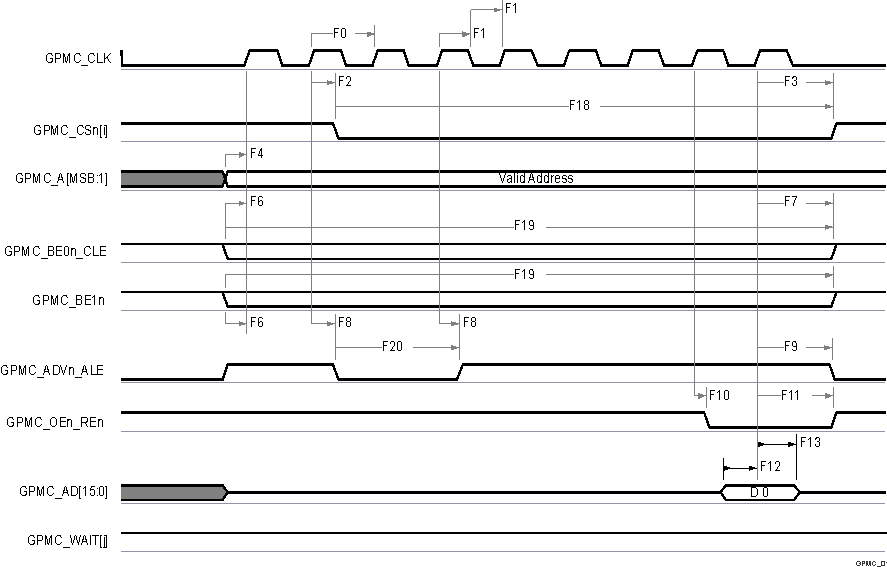
A. In GPMC_CSn[i], i is equal to 0,
1, 2 or 3.
B. In GPMC_WAIT[j], j is equal to 0
or 1.
Figure 6-50 GPMC and
NOR Flash — Synchronous Single Read (GPMCFCLKDIVIDER = 0) 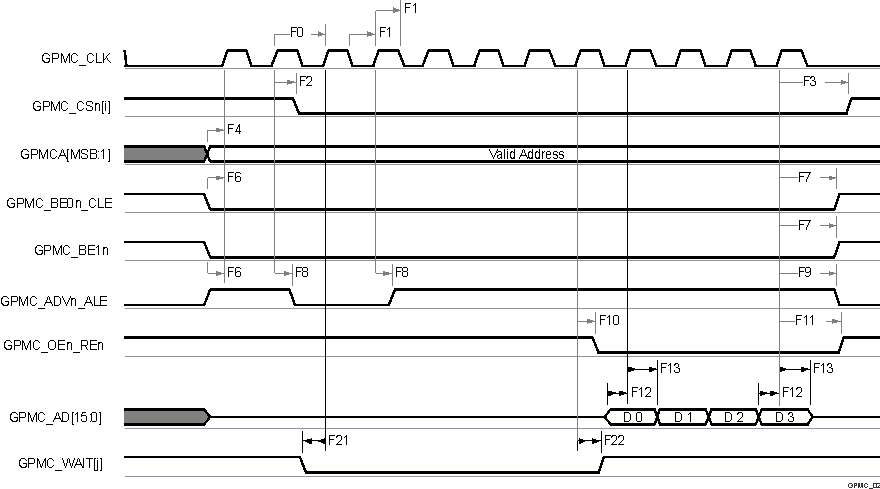
A. In GPMC_CSn[i], i is equal to 0,
1, 2 or 3.
B. In GPMC_WAIT[j], j is equal to 0
or 1.
Figure 6-51 GPMC and
NOR Flash — Synchronous Burst Read — 4x16–bit (GPMCFCLKDIVIDER = 0) 
A. In GPMC_CSn[i], i is equal to 0,
1, 2 or 3.
B. In GPMC_WAIT[j], j is equal to 0
or 1.
Figure 6-52 GPMC and
NOR Flash—Synchronous Burst Write (GPMCFCLKDIVIDER = 0) 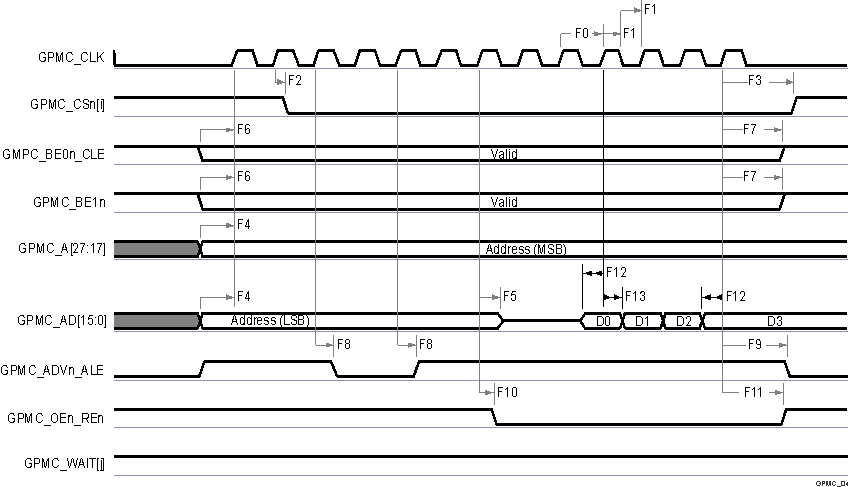
A. In GPMC_CSn[i], i is equal to 0,
1, 2 or 3.
B. In GPMC_WAIT[j], j is equal to 0
or 1.
Figure 6-53 GPMC and
Multiplexed NOR Flash — Synchronous Burst Read 
A. In GPMC_CSn[i], i is equal to 0,
1, 2 or 3.
B. In GPMC_WAIT[j], j is equal to 0
or 1.
Figure 6-54 GPMC and
Multiplexed NOR Flash — Synchronous Burst Write