TIDUFD0 August 2025
2.2.2 Auxiliary Power Strategy
Configure the #B0 AVDD as on to enable UART when #B0 is in shutdown mode. In theory, #B0 AVDD can be used to power the wBMS MCU, level shifter, and multiplexer but this configuration increases the current consumption of #B0. To avoid this, the design built an onboard power rail to power the wBMS MCU rather than use #B0 AVDD. Figure 2-4 shows the strategy for this design.
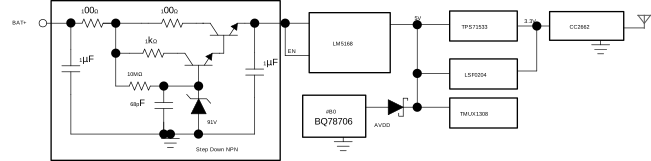 Figure 2-4 Auxiliary Power Strategy
The low-voltage ESS power strategy has a 120V input, 0.3A, ultra-low IQ synchronous buck DC/DC converter LM5168P with a low IQ 50mA LDO TPS71533 as the main power source, giving the system better efficiency and thermal performance than LDOs only.
A discrete step-down circuit is added before DC/DC because the 52s battery pack voltage can exceed 120V. Two NPN transistors are used in the step-down circuit to increase the DC current gain to lower the quiescent current. #B0 AVDD is connected to the output of DC/DC for redundancy. The CC2662R-Q1 is powered by #B0 AVDD if the LM5168 or step-down NPN circuit is failed. Set the LM5168 output voltage slightly above 5V, allowing the Schottky diodes to be reversed under normal operating conditions.
The auxiliary power rail can eliminate the current difference caused by the extra load on #B0 AVDD, but the power rail adds extra devices which create more complexity and cost. Figure 2-5 shows a low-cost alternative configuration.
 Figure 2-5 Low-Cost Power Strategy Option
BQ78706 AVDD allows a maximum 20mA external load, so the CC2662R-Q1, which only requires about 10mA peak supply current, can be powered directly from the AVDD. Three dummy resistive loads, controlled by the BQ78706 GPIO, are added to balance the current consumption.