TIDUFE3 July 2025
- 1
- Description
- Resources
- Features
- Applications
- 6
- 1System Description
- 2System Overview
- 3System Design Theory
- 4Hardware, Software, Testing Requirements, and Test Results
- 5Design and Documentation Support
- 6About the Author
4.3.1 Linearity Tests
For this test, this reference design is connected to a microcontroller for the SPI of the AFE and the analog output is connected to a power supply and an ammeter. The whole system is run from the current on the loop and interfaced to a PC through an isolated UART. All tests are done with 10V and 24V loop voltage, with AFE881H1 in 3.3V and 1.8V configuration, for AFE882H1 in 3.3V configuration. The DAC code is stepped and the current reading of the ammeter is recorded.
Figure 4-4 shows the complete setup.
 Figure 4-4 Test Setup for Linearity Test
Figure 4-5 through Figure 4-16 show the linearity including a linear trend line which is also used for calculating the error. Therefore the equation is used to calculate the ideal current and the difference to the measurement is shown. For each 10V to 24V configuration, the same equation is used to calculate the error, simulating a calibration at a bias point and then operating at a different one. The different equations are shown for reference.
 Figure 4-5 AFE881: 1.8V Supply, 10V Loop Linearity
y = 3.35466E–04x + 2.99760
 Figure 4-7 AFE881: 1.8V Supply, 24V Loop Linearity
y = 3.35485E–04x + 2.99755
 Figure 4-9 AFE881: 3.3V Supply, 10V Loop Linearity
y = 3.35189E–04x + 2.99416

Figure 4-11 AFE881: 3.3V Supply, 24V Loop Linearity
y = 3.35312E–04x + 2.99208
 Figure 4-13 AFE882: 3.3V Supply, 10V Loop Linearity
y = 3.19149E–04x + 3.04646
 Figure 4-15 AFE882: 3.3V Supply, 24V Loop Linearity
y = 3.19127E–04x + 3.04673
 Figure 4-6 AFE881: 1.8V Supply, 10V Loop Error
 Figure 4-8 AFE881: 1.8V Supply, 24V Loop Error
 Figure 4-10 AFE881: 3.3V Supply, 10V Loop Error
 Figure 4-12 AFE881: 3.3V Supply, 24V Loop Error
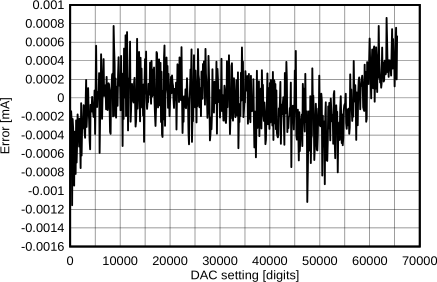 Figure 4-14 AFE882: 3.3V Supply, 10V Loop Error
 Figure 4-16 AFE882: 3.3V Supply, 24V Loop Error