SBOSAA4B April 2025 – August 2025 INA1H94-SP
PRODUCTION DATA
- 1
- 1 Features
- 2 Applications
- 3 Description
- 4 Pin Configuration and Functions
- 5 Specifications
- 6 Detailed Description
- 7 Application and Implementation
- 8 Device and Documentation Support
- 9 Revision History
- 10Mechanical, Packaging, and Orderable Information
Package Options
Mechanical Data (Package|Pins)
- HKX|8
Thermal pad, mechanical data (Package|Pins)
Orderable Information
6.3.1 Common-Mode Range
Figure 6-1 shows the basic connections required for dual-supply operation. Applications with noisy or high-impedance power-supply lines can require decoupling capacitors placed close to the device pins. The output voltage is equal to the differential input voltage between pins 1 and 8. The common-mode input voltage is rejected. Figure 6-2 shows the basic connections required for single-supply operation.
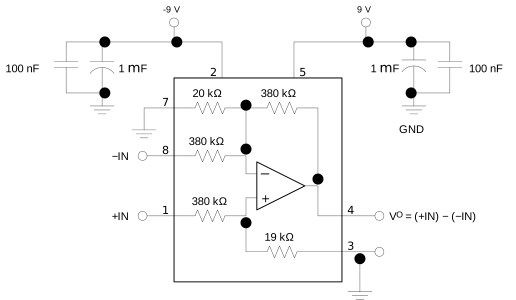 Figure 6-1 Power and Signal Connections for Dual-Supply Operation
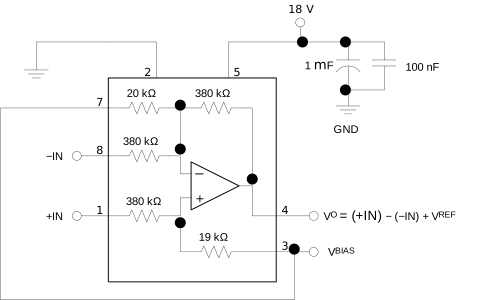 Figure 6-2 Power and Signal Connections for Single-Supply Operation
Most applications use the INA1H94-SP as a simple unity-gain difference amplifier. Equation 1 shows the transfer function:
Some applications, however, apply voltages to the reference terminals (REFA and REFB). Equation 2 shows the complete transfer function:
The high common-mode range of the INA1H94-SP is achieved by dividing down the input signal with a high precision resistor divider. This resistor divider brings both the positive input and the negative input within the input range of the internal operational amplifier. This input range depends on the supply voltage of the INA1H94-SP.
Figure 5-1 can be used to determine the maximum common-mode range for a specific supply voltage. The maximum common-mode range can also be calculated by ensuring that both the positive and the negative input of the internal amplifier are within 1.5V of the supply voltage.
In case the voltage at the inputs of the internal amplifier exceeds the supply voltage, the internal ESD diodes start conducting current. This current must be limited to 10mA to make sure not to exceed the absolute maximum ratings for the device.