SBOSAL2 September 1999 – January 2025 LMC7101
PRODUCTION DATA
- 1
- 1 Features
- 2 Applications
- 3 Description
- 4 Pin Configuration and Functions
-
5 Specifications
- 5.1 Absolute Maximum Ratings
- 5.2 ESD Ratings
- 5.3 Recommended Operating Conditions
- 5.4 Thermal Information
- 5.5 Electrical Characteristics for VS = ±1.35V or 2.7V
- 5.6 Electrical Characteristics for VS = ±1.5V or 3V
- 5.7 Electrical Characteristics for VS = ±2.5V or 5V
- 5.8 Electrical Characteristics for VS = ±7.5V or 15V
- 5.9 Typical Characteristics for VS = 2.7V
- 5.10 Typical Characteristics for VS = 3V
- 5.11 Typical Characteristics for VS = 5V
- 5.12 Typical Characteristics for VS = 15V
- 6 Detailed Description
- 7 Application and Implementation
- 8 Device and Documentation Support
- 9 Revision History
- 10Mechanical, Packaging, and Orderable Information
Package Options
Refer to the PDF data sheet for device specific package drawings
Mechanical Data (Package|Pins)
- DBV|5
Thermal pad, mechanical data (Package|Pins)
Orderable Information
6.4.1.1 Input Common-Mode Voltage Range
The LMC7101 does not exhibit phase inversion when an input voltage exceeds the negative supply voltage. Figure 6-1 shows an input voltage exceeding both supplies with no resulting phase inversion of the output.
The absolute maximum input voltage is 300mV beyond either rail at room temperature. Voltages greatly exceeding this maximum rating, as in Figure 6-2, can cause excessive current to flow in or out of the input pins, thus adversely affecting reliability.

| The input voltage signal exceeds the amplifier power supply voltage with no output phase inversion. |

| The ±7.5V input signal greatly exceeds the 3V supply in Figure 6-3 causing no phase inversion due to RI. |
Applications that exceed this rating must externally limit the maximum input current to ±5mA with an input resistor as shown in Figure 6-3.
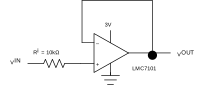 Figure 6-3 RI Input Current
Protection for Voltages Exceeding the Supply Voltage
Figure 6-3 RI Input Current
Protection for Voltages Exceeding the Supply Voltage