SBOSAG7 April   2025 TMCS1143

ADVANCE INFORMATION  

  1.   1
  2. Features
  3. Applications
  4. Description
  5. Device Comparison
  6. Pin Configuration and Functions
  7. Specifications
    1. 6.1 Absolute Maximum Ratings
    2. 6.2 ESD Ratings
    3. 6.3 Recommended Operating Conditions
    4. 6.4 Thermal Information
    5. 6.5 Power Ratings
    6. 6.6 Insulation Specifications
    7. 6.7 Safety Limiting Values
    8. 6.8 Electrical Characteristics
  8. Typical Characteristics
    1. 7.1 Insulation Characteristics Curves
  9. Parameter Measurement Information
    1. 8.1 Accuracy Parameters
      1. 8.1.1 Sensitivity Error
      2. 8.1.2 Offset Error and Offset Error Drift
      3. 8.1.3 Nonlinearity Error
      4. 8.1.4 Power Supply Rejection Ratio
      5. 8.1.5 Common-Mode Rejection Ratio
      6. 8.1.6 External Magnetic Field Errors
    2. 8.2 Transient Response Parameters
      1. 8.2.1 CMTI, Common-Mode Transient Immunity
    3. 8.3 Safe Operating Area
      1. 8.3.1 Continuous DC or Sinusoidal AC Current
      2. 8.3.2 Repetitive Pulsed Current SOA
      3. 8.3.3 Single Event Current Capability
  10. Detailed Description
    1. 9.1 Overview
    2. 9.2 Functional Block Diagram
    3. 9.3 Feature Description
      1. 9.3.1 Current Input
      2. 9.3.2 Ambient Field Rejection
      3. 9.3.3 High-Precision Signal Chain
        1. 9.3.3.1 Temperature Stability
        2. 9.3.3.2 Lifetime and Environmental Stability
      4. 9.3.4 Internal Reference Voltage
      5. 9.3.5 Current-Sensing Measurable Ranges
      6. 9.3.6 Overcurrent Detection
        1. 9.3.6.1 Setting The User Configurable Overcurrent Threshold
          1. 9.3.6.1.1 Setting Overcurrent Threshold Using Power Supply Voltage
          2. 9.3.6.1.2 Setting Overcurrent Threshold Using Internal Reference Voltage
          3. 9.3.6.1.3 Setting Overcurrent Threshold Example
        2. 9.3.6.2 Overcurrent Output Response
      7. 9.3.7 Sensor Diagnostics
        1. 9.3.7.1 Thermal Alert
        2. 9.3.7.2 Sensor Alert
    4. 9.4 Device Functional Modes
      1. 9.4.1 Power-Down Behavior
  11. 10Application and Implementation
    1. 10.1 Application Information
      1. 10.1.1 Total Error Calculation Examples
        1. 10.1.1.1 Room-Temperature Error Calculations
        2. 10.1.1.2 Full-Temperature Range Error Calculations
    2. 10.2 Typical Application
      1. 10.2.1 Design Requirements
      2. 10.2.2 Detailed Design Procedure
      3. 10.2.3 Application Curve
    3. 10.3 Power Supply Recommendations
    4. 10.4 Layout
      1. 10.4.1 Layout Guidelines
      2. 10.4.2 Layout Example
  12. 11Device and Documentation Support
    1. 11.1 Device Nomenclature
    2. 11.2 Device Support
      1. 11.2.1 Development Support
    3. 11.3 Documentation Support
      1. 11.3.1 Related Documentation
    4. 11.4 Receiving Notification of Documentation Updates
    5. 11.5 Support Resources
    6. 11.6 Trademarks
    7. 11.7 Electrostatic Discharge Caution
    8. 11.8 Glossary
  13. 12Revision History
  14. 13Mechanical, Packaging, and Orderable Information
    1. 13.1 Mechanical Data
    2.     PACKAGING INFORMATION
    3. 13.2 Tape and Reel Information

Refer to the PDF data sheet for device specific package drawings

Mechanical Data (Package|Pins)
  • DVF|10
Thermal pad, mechanical data (Package|Pins)

CMTI, Common-Mode Transient Immunity

CMTI is the capability of the device to tolerate a rising or falling voltage step on the input without coupling significant disturbance on the output signal. The device is specified for the maximum common-mode transition rate when the output signal does not experience a disturbance greater than 200mV lasting longer than 1µs, as shown in Figure 8-3 with a 150kV/µs common-mode input step. Higher edge rates than the specified CMTI can be supported with sufficient filtering or blanking time after common-mode transitions.
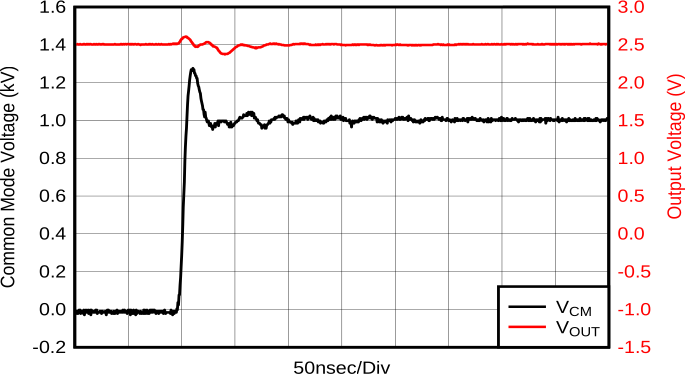
TMCS1143 Common-Mode
                                        Transient Response TMCS1143 Common-Mode
                                        Transient Response Figure 8-3 Common-Mode Transient Response