SLOSEF7 July 2025 TRF1305C1
PRODUCTION DATA
- 1
- 1 Features
- 2 Applications
- 3 Description
- 4 Device Comparison Table
- 5 Pin Configuration and Functions
-
6 Specifications
- 6.1 Absolute Maximum Ratings
- 6.2 ESD Ratings
- 6.3 Recommended Operating Conditions
- 6.4 Thermal Information
- 6.5 Electrical Characteristics - AC Specifications in D2D Configuration
- 6.6 Electrical Characteristics - AC Specifications in S2D Configuration
- 6.7 Electrical Characteristics - DC and Timing Specifications
- 6.8 Typical Characteristics: D2D Configuration
- 6.9 Typical Characteristics: S2D Configuration
- 7 Detailed Description
- 8 Application and Implementation
- 9 Device and Documentation Support
- 10Revision History
- 11Mechanical, Packaging, and Orderable Information
Package Options
Refer to the PDF data sheet for device specific package drawings
Mechanical Data (Package|Pins)
- RPV|12
Thermal pad, mechanical data (Package|Pins)
Orderable Information
8.2.1.2 Detailed Design Procedure
The first step is to choose the TRF1305C1 supplies. Ensure that the midsupply voltage, VMIDSUPPLY, is between the ADC common-mode (CM) voltage and the mixer CM voltage. VMIDSUPPLY is typically positioned closer to the ADC CM because the output CM range of the amplifier is less than the input CM range. Ensure that the dc of the signal at the input and output of the amplifier are within the valid operating common-mode voltage range. Use the MODE pin for cases where an extended range of the input CM is required.
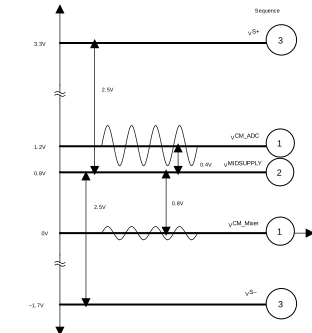 Figure 8-7 Choosing Supply Voltages With
Given Common-Mode Voltages
Figure 8-7 Choosing Supply Voltages With
Given Common-Mode VoltagesFigure 8-7 shows how VMIDSUPPLY is chosen to be 0.8V, so that the amplifier input has a CM offset from VMIDSUPPLY of 0.8V and output has a CM offset from VMIDSUPPLY of 0.4V (1.2V – 0.8V). The CM offsets are within the valid common-mode range of the amplifier, so the supplies of the TRF1305C1 are chosen to be VS+ = 3.3V (0.8V + 2.5V) and VS– = −1.7V (0.8V – 2.5V). Further optimization in the choice of supply is possible by selecting the input and output CM voltages for the best OIP3 performance. Section 8.2.1.3 has contour graphs that show OIP3 across input and output common-mode voltages.
The output CM is greater than the input CM; therefore, a net 10.5mA ((1.2V – 0V) / (97Ω + 17Ω)) dc current flows from the output to input through the internal feedback resistors. Depending on the choice of the passive mixer, this current can required to be sunk outside the mixer so that the bias conditions of the mixer are not disturbed. A 162Ω pulldown resistor connected to the INP pin to −1.7V supply is adequate. If the 10.5mA dc current is sourced entirely from the amplifier, then the output headroom can be affected. Therefore, source the current externally from the supply using a pair of pullup resistors connected to the amplifier outputs; 196Ω pullup resistors from OUTP and OUTM to 3.3V are adequate.
The I-channel mixer output has a 50Ω port and is connected to the amplifier INP pin through a small (4.7Ω) series resistor. The INM pin is terminated to ground through a 68Ω resistor and to −1.7V through a 162Ω resistor. This configuration allows the amplifier to have the same input impedance at each of the INP and INM input pins. The impedance of the mixer is close to 43Ω and provides better than a −20dB return loss (theoretically). Be aware that there is some drop in the gain due to these resistor networks. The values of the resistors chosen in Figure 8-6 are a good starting point; in practice, some adjustment is often needed to simultaneously meet the dc conditions and the RF performance.
At the amplifier output, a 3dB pad with a 100Ω differential impedance is used to match to the antialiasing filter with a 100Ω differential input impedance. The filter output is connected to ADC with appropriate matching. Figure 8-6 only shows the I-channel; the Q-channel has an identical configuration.