SLOSEF7 July 2025 TRF1305C1
PRODUCTION DATA
- 1
- 1 Features
- 2 Applications
- 3 Description
- 4 Device Comparison Table
- 5 Pin Configuration and Functions
-
6 Specifications
- 6.1 Absolute Maximum Ratings
- 6.2 ESD Ratings
- 6.3 Recommended Operating Conditions
- 6.4 Thermal Information
- 6.5 Electrical Characteristics - AC Specifications in D2D Configuration
- 6.6 Electrical Characteristics - AC Specifications in S2D Configuration
- 6.7 Electrical Characteristics - DC and Timing Specifications
- 6.8 Typical Characteristics: D2D Configuration
- 6.9 Typical Characteristics: S2D Configuration
- 7 Detailed Description
- 8 Application and Implementation
- 9 Device and Documentation Support
- 10Revision History
- 11Mechanical, Packaging, and Orderable Information
Package Options
Refer to the PDF data sheet for device specific package drawings
Mechanical Data (Package|Pins)
- RPV|12
Thermal pad, mechanical data (Package|Pins)
Orderable Information
8.1.2 Gain Adjustment With External Resistors in a Differential Input Configuration
The TRF1305x1 allow minor gain adjustments by configuring the input external resistive network that is part of the differential input configuration. Figure 8-5 shows the external input network that comprises of a shunt resistor, RIN_SH, and two series input resistors, RIN_SER, connected to the input pins of the amplifier.
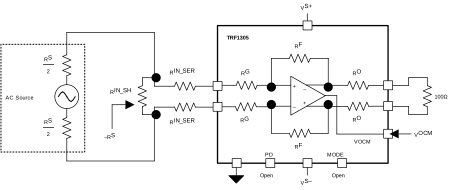 Figure 8-5 Gain Adjustment With External
Resistor Network
Figure 8-5 Gain Adjustment With External
Resistor NetworkTable 8-1 provides resistor configurations for a 100Ω differential source impedance.
| TRF1305C1 | ||
|---|---|---|
| POWER GAIN (dB) | RIN_SH (Ω) | RIN_SER (Ω) |
| 5 | 1000 | 25 |
| 4 | 434 | 30 |
| 3 | 288 | 36 |
| 2 | 222 | 42 |
| 1 | 184 | 49 |
| 0 | 160 | 57 |
Use external resistive attenuation network only for small gain adjustments because there is a dB-to-dB noise figure degradation with the resistive attenuators. Use an amplifier version that requires minimal attenuation for achieving the overall gain.