SBOA578 January 2025 TMCS1123 , TMCS1123-Q1 , TMCS1126 , TMCS1127 , TMCS1127-Q1 , TMCS1133 , TMCS1133-Q1
4 Case 1: Copper Weight
The first case examined is device thermal capability with regard to copper weight. For each experimental run, the exact footprint of the TMCS1123 evaluation module was kept intact, and the stack layers were changed to indicated copper weight. Figure 4-1 shows the typical footprint of the TMCS1123EVM. Figure 4-2 through Figure 4-7 show measured data for 1oz through 6oz copper, respectively.
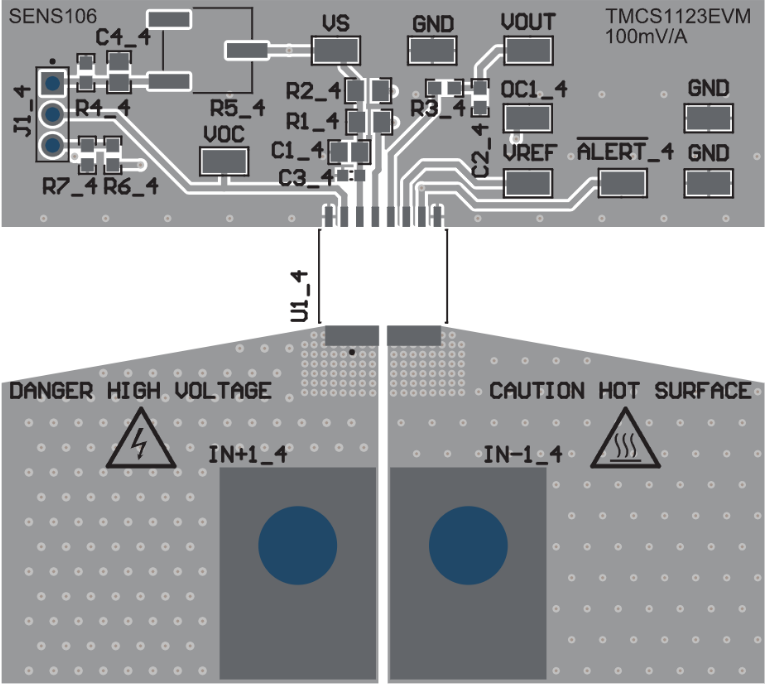 Figure 4-1 TMCS1123EVM Portion, A4 Variant, Sensitivity = 100mV/A
 Figure 4-2 TMCS1123EVM Thermal Response Curves for 5 Devices, 1 Oz Copper
 Figure 4-4 TMCS1123EVM Thermal Response Curves for 5 Devices, 3Oz Copper
 Figure 4-6 TMCS1123EVM Thermal Response Curves for 5 Devices, 5 Oz Copper
 Figure 4-3 TMCS1123EVM Thermal Response Curves for 5 Devices, 2 Oz Copper
 Figure 4-5 TMCS1123EVM Thermal Response Curves for 5 Devices, 4Oz Copper
 Figure 4-7 TMCS1123EVM Thermal Response Curves for 5 Devices, 6 Oz Copper
Figure 4-8 examines the same curves captured above, and overlays all data on top of one another to examine improvements by weight as current grows.
 Figure 4-8 TMCS1123EVM Thermal Response Curves for all Copper Weights
From the chart, the following observations can be made:
- A doubling of copper results in roughly the same magnitude improvement, at least at lower thickness levels. From 1oz to 2oz, an approximate 10A improvement from 55A to 65A. At the 4oz mark, move to 75A capability, which is again a 10A improvement, for a doubling from 2oz to 4oz. However, also, the 6oz copper was capable of 85A, which by the same relationship can be expected of 8oz copper.
- At higher copper levels, for example, beyond 4oz, we begin to see diminishing returns in capability. While 6oz is still an improvement over 5oz, and 5oz is an improvement over 4, these curves are much tighter in distribution, with some worst case devices matching best case performance of the next copper weight.
- As stated previously, board manufacturing tolerances and capabilities can change the thermal profile from board to board. As an example, examining the 1oz data shows that at the point the worst performing device reaches 165°C, the best performing device is only at 145°C. As such, it is imperative that sufficient headroom be made in the design to make sure of success in the face of lot to lot variation