SBOA620 March 2025 TMCS1126 , TMCS1126-Q1 , TMCS1133 , TMCS1133-Q1
3.1 Design of the TMCS112x and TMCS112x3x EMI Topology
To design the desired topology, we begin with the overall schematic presented in Figure 3-1. This schematic implements components necessary for EMI resiliency on all pins of the low-voltage side of the TMCS112x/3x. Also note that in most design use cases, not all of these components are necessary. Proper testing needs to be conducted to determine on which pins noise propagates, and the appropriate implementation is needed on those pins only. Note that C1, C5, and C6 are not populated by default. These capacitors help to address common-mode noise in the system, but come with potential bandwidth limitations that must be considered. The effects of these capacitors can be discussed later in the application note.
 Figure 3-1 Schematic for EMI Resilience
on all Low Voltage Pins of TMCS112x and TMCS112x3x, CM and DM Noise
Figure 3-1 Schematic for EMI Resilience
on all Low Voltage Pins of TMCS112x and TMCS112x3x, CM and DM NoiseThe main device used to combat EMI here is the ferrite bead. Ferrite beads can be used on signal paths to reduce noise on differential lines, and suppress high-frequency signals that can cause problems in the circuit. The ferrite beads provide the following benefits:
- Low DC resistance when placed in the series path of a signal, resulting in a minimal voltage drop for the DC portion of the signal. This makes them designed for DC signals, such as potentially noisy supply voltages
- A variable AC impedance, RAC, that attenuates a specific band of frequencies based on the specific devices' data sheet
- Ferrite beads dissipate energy as heat, unlike inductors, which store energy. This allows the device to reduce noise at targeted frequencies while preserving the integrity of the signal chain
- Used in conjunction with capacitors, LC filter combinations result in a -40dB/decade attenuation, where traditional RC filters can only provide -20dB/decade attenuation
Every ferrite bead can be slightly different due to not only the properties discussed previously, but also the parasitics associated with the device. These parasitics are typically inherent to the device, and can depend on dimensions, material, footprint, and several other factors. Due to the complexity, these parasitics bring to the design, this is recommended, when available, that filter design be completed through the use of manufacturer provided spice models, as the parasitics present in the device can affect both the magnitude and location of the resonant peak formed by the filter. An example properties curve is shown for the Murata BLM31KN102SH1L size 1206, 1kΩ at 1MHz ferrite bead in Figure 3-2.
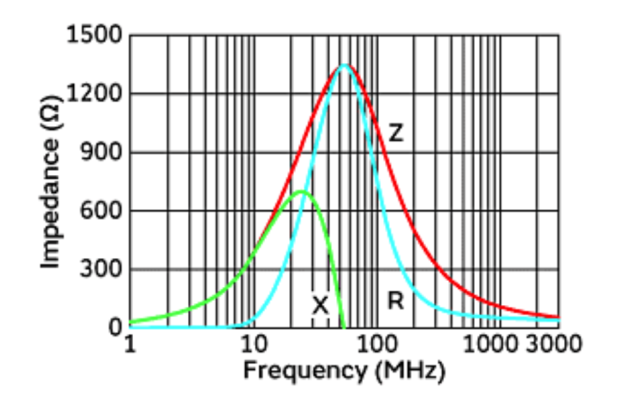 Figure 3-2 Murata BLM31KN102SH1L Ferrite
Bead Characteristic Impedance Curves
Figure 3-2 Murata BLM31KN102SH1L Ferrite
Bead Characteristic Impedance Curves