SLUUD32A June 2024 – April 2025
- 1
- Description
- Features
- 4
- 1Evaluation Module Overview
- 2BQ41Z50EVM Quick Start Guide
- 3Hardware
- 4Software
- 5IT-DZT Guide To Gauging
- 6Hardware Design Files
- 7Additional Information
- 8Related Documentation
- 9Revision History
5.6 Results
The graphs below show various metrics obtained during the sample IT-DZT implementation described in the previous section.
The Figure 5-11 below shows the capacity accuracy prediction under a dynamic discharge load. Notice how the SOC error percent is within 2%.
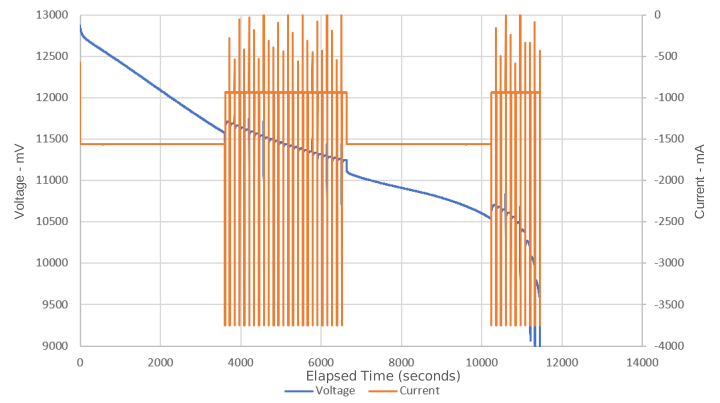 Figure 5-10 Application Load
 Figure 5-11 SOC Accuracy
See Figure 5-12 for a plot of the remaining capacity and the full charge capacity throughout the cycle. Note that the FCC can not be accurate until the end of the first cycle. Notice that the FCC remains approximately the same during all discharge cycles.
 Figure 5-12 Remaining Capacity and FCC Estimations
The table to the left in Figure 5-13 below shows the Ra table during the start of the cycle, these are the default values programmed to the gauge after programming the chemID using bqStudio. The table to the right, includes the updates made to the Ra tables. The individual cell R_a flags update to 0x0055 which implies that both cell impedance and Qmax were updated and the table is being used. The left table indicates before the test. The right table indicates after the test.
 Figure 5-13 Ra Update
Figure 5-14 below shows a comparison of IT and IT-DZT algorithms. The blue and orange plots are based on a BQ40Z50 IT gauge and the BQ41Z50 IT-DZT gauge, both under dynamic load as shown in Dynamic Load. These are compared against the golden Ra obtained after ID characterization which is called "Expected Ra".
 Figure 5-14 IT vs IT-DZT vs Expected Ra
As can be seen in the results above, the IT-DZT algorithm measures resistance more accurately during dynamic load scenarios compared to the standard IT algorithm due to its need of long settling times during discharge cycles to update the Ra table. The tests run on the gauge indicate short periodic fluctuating loads, which is an ideal use case for Dynamic Z-Track™ gauges.
Impedance Track™ is highly accurate with constant current loads. A comparison between an IT gauge (BQ40Z50) under constant load and BQ41Z50 under dynamic load is shown in the Figure 5-15 below. Note that the difference in R_a values between IT-DZT and IT Gauging is under 15%.
 Figure 5-15