SLYT866 May 2025 ADC32RF52 , ADC32RF54 , ADC32RF55 , ADC32RF72 , ADC34RF52 , ADC34RF55 , ADC34RF72 , ADC3548 , ADC3549 , ADC3568 , ADC3569 , ADC3648 , ADC3649 , ADC3668 , ADC3669
- 1
- 2
- 1Nyquist rules
- 2What is process gain?
- 3Why frequency plan?
- 4Common pitfalls in frequency planning
- 5Advantages of proper frequency planning using decimation
- 6Theoretical example: Frequency planning with decimation
- 7Real World Examples: Frequency planning with decimation
- 8Conclusion
- 9Related Websites
1 Nyquist rules
Super Nyquist sampling, intermediate frequency (IF) sampling and subsampling are popular in many frequency-based applications that employ software-defined radio (SDR) or radar-like receiver architectures (see Figure 1).
 Figure 1 Example of a super Nyquist
sample vs. sampling at baseband (first Nyquist).
Figure 1 Example of a super Nyquist
sample vs. sampling at baseband (first Nyquist).There are two main reasons to plan frequencies outside of baseband (first Nyquist). The first reason is to gain the relaxation constraints put on the antialiasing filter design (AAF) (see Figure 2). Initially, the general filter rolloff needs to be much steeper when designing a baseband filter versus a filter design for a higher Nyquist zone. A steeper filter rolloff leads to a more complex filter where passive components become cumbersome. It’s simple physics; you cannot purchase a 100µH inductor in a 0201 size. Therefore, when employing a higher Nyquist zone and possibly a higher sampling rate, the trade-offs and requirements for the rolloff in the stopband region are more relaxed, resulting in fewer components and smaller component sizes.
The second reason to use the high-frequency subsampling technique is to relax the radio-frequency (RF) receiver signal chain in front of the ADC. Assuming that the ADC can support the bandwidth requirements beyond the first Nyquist, which is almost always the case, relaxing the receiver signal chain could eliminate one or even two mix-down stages in the RF signal chain, resulting in even fewer components, less noise and less complexity.
 Figure 2 Dynamic range vs. AAF
stop-band attenuation.
Figure 2 Dynamic range vs. AAF
stop-band attenuation.For example, Figure 3 shows the Texas Instruments (TI) ADC3669 sampling an intermediate frequency of 800MHz relative to a 500 MSPS sampling frequency (Fs). Essentially, the signal is in the fourth Nyquist zone. The image or alias of the interest frequency reflects back to the first Nyquist zone appearing as a 200MHz signal. Most fast Fourier transform (FFT) analyzers, such as High-Speed Data Converter Pro, only plot an FFT of the first Nyquist zone, or 0Fs to 0.5Fs. Therefore, if the frequency of interest is above 0.5Fs, an image reflects down to the first Nyquist zone or baseband. This can make things confusing if spurious tones are in the band of interest as well.
So how does an ADC sample above 0.5Fs and still hold true to the Nyquist criteria? The Nyquist rule states that a signal must be sampled at a rate equal to or greater than twice its bandwidth in order to preserve all of the signal’s information (see Equation 1):
where Fs is the sample frequency and FBW is the maximum frequency of interest.
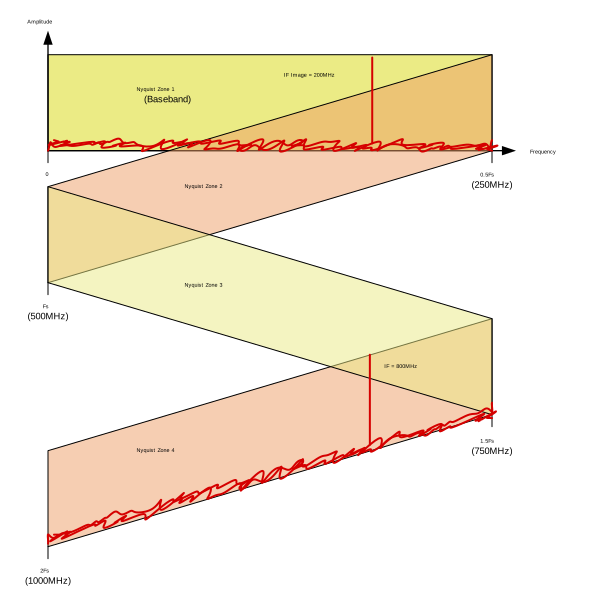 Figure 3 ADC3669 example, where Fs =
500MSPS and the intermediate frequency = 800MHz.
Figure 3 ADC3669 example, where Fs =
500MSPS and the intermediate frequency = 800MHz.The key to holding the Nyquist rule to be true is the location of the frequencies of interest. As long as the signals do not overlap and stay within a single Nyquist zone, the Nyquist criteria still holds true. The only thing that has changed is the location of the first Nyquist zone to a higher one. IF sampling is becoming very popular because of these trade-offs.