SNVSCO2 November 2025 LM51261A-Q1
PRODUCTION DATA
- 1
- 1 Features
- 2 Applications
- 3 Description
- 4 Pin Configuration and Functions
- 5 Specifications
-
6 Detailed Description
- 6.1 Overview
- 6.2 Functional Block Diagram
- 6.3
Feature Description
- 6.3.1 Device Configuration (CFG-pin)
- 6.3.2 Device Enable/Disable (UVLO/EN)
- 6.3.3 Dual Device Operation
- 6.3.4 Switching Frequency and Synchronization (SYNCIN)
- 6.3.5 Dual Random Spread Spectrum (DRSS)
- 6.3.6 Operation Modes (BYPASS, DEM, FPWM)
- 6.3.7 VCC Regulator, BIAS (BIAS-pin, VCC-pin)
- 6.3.8 Soft Start (SS-pin)
- 6.3.9 VOUT Programming (VOUT, ATRK, DTRK)
- 6.3.10 Protections
- 6.3.11 Fault Indicator (nFAULT-pin)
- 6.3.12 Slope Compensation (CSP, CSN)
- 6.3.13 Current Sense Setting and Switch Peak Current Limit (CSP, CSN)
- 6.3.14 Input Current Limit and Monitoring (ILIM, IMON, DLY)
- 6.3.15 Maximum Duty Cycle and Minimum Controllable On-time Limits
- 6.3.16 Signal Deglitch Overview
- 6.3.17 MOSFET Drivers, Integrated Boot Diode, and Hiccup Mode Fault Protection (LO, HO, HB-pin)
- 6.3.18 I2C Features
- 6.4 Device Functional Modes
- 6.5 Programming
- 7 LM51261A-Q1 Registers
-
8 Application and Implementation
- 8.1 Application Information
- 8.2
Typical Application
- 8.2.1 Design Requirements
- 8.2.2
Detailed Design Procedure
- 8.2.2.1 Determine the Total Phase Number
- 8.2.2.2 Determining the Duty Cycle
- 8.2.2.3 Timing Resistor RT
- 8.2.2.4 Inductor Selection Lm
- 8.2.2.5 Current Sense Resistor Rcs
- 8.2.2.6 Current Sense Filter RCSFP, RCSFN, CCS
- 8.2.2.7 Low-Side Power Switch QL
- 8.2.2.8 High-Side Power Switch QH
- 8.2.2.9 Snubber Components
- 8.2.2.10 Vout Programming
- 8.2.2.11 Input Current Limit (ILIM/IMON)
- 8.2.2.12 UVLO Divider
- 8.2.2.13 Soft Start
- 8.2.2.14 CFG Settings
- 8.2.2.15 Output Capacitor Cout
- 8.2.2.16 Input Capacitor Cin
- 8.2.2.17 Bootstrap Capacitor
- 8.2.2.18 VCC Capacitor CVCC
- 8.2.2.19 BIAS Capacitor
- 8.2.2.20 VOUT Capacitor
- 8.2.2.21 Loop Compensation
- 8.2.3 Application Curves
- 8.3 Power Supply Recommendations
- 8.4 Layout
- 9 Device and Documentation Support
- 10Revision History
- 11Mechanical, Packaging, and Orderable Information
6.3.3 Dual Device Operation
For 3-phase operation the LM51261A-Q1 device (secondary) can be stacked in combination with the LM51251A-Q1 device (primary). For dual device configuration the phase shift between the phases is set by I2C programming. The primary device (LM51251A-Q1) switching frequency can be synchronized to an external clock applied at the primary device SYNCIN-pin (see Switching Frequency and Synchronization (SYNCIN)). The primary device sets the switching frequency and communicates the operation mode via the SYNCOUT-pin to the secondary device.
The SINGLE_DUAL-bit selects following settings:
| Single Device: | The device is used standalone using the internal oscillator. |
| Single Device ext. clock: | The device is used standalone using the internal clock and synchronizes to an external clock if applied. |
| SYNCIN: | Defines if the clock syncing function at the SYNCIN-pin is active (on) or disabled (off). The device is only syncing to an external clock applied to the SYNCIN-pin when SYNCIN is active. |
| Clock Dithering: | In case the internal oscillator is used the clock dithering is selected by the SPREAD_SPECTRUM-bit setting. When external clock is selected the clock dithering function is disabled ignoring the SPREAD_SPECTRUM-bit setting. |
| Pin | Primary SYNCIN = off | Primary SYNCIN = on | Secondary |
|---|---|---|---|
| SYNCIN | Disabled |
High: Use internal oscillator. Pulse: Sync to external clock. Low: Use internal oscillator. |
High: Bypass mode. Pulse: Operation as defined by MODE-pin. Low: Stop switching. |
| SYNCOUT |
High: Communicate bypass mode to secondary device. Pulse: Communicate normal operation. Low: Communicate stop switching to secondary device. |
High: Communicate bypass mode to secondary device. Pulse: Communicate normal operation. Low: Communicate stop switching to secondary device. |
Disabled |
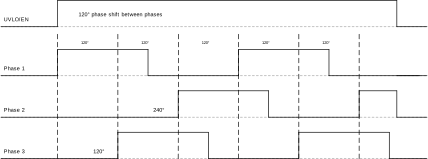 Figure 6-3 2 Devices 3-phase
Operation
Figure 6-3 2 Devices 3-phase
Operation Figure 6-4 3-Phase Configuration
 Figure 6-5 Typical Application 3-phase Operation