TIDUF27A February 2025 – March 2025 AMC131M03 , MSPM0G1507
- 1
- Description
- Resources
- Features
- Applications
- 6
- 1System Description
-
2System Overview
- 2.1 Block Diagram
- 2.2
Design Considerations
- 2.2.1 Voltage Measurement Analog Front End
- 2.2.2 Analog Front End for Current Measurement
- 2.2.3 XDS110 Emulator
- 2.2.4 Bluetooth® Data Transmission
- 2.2.5 Bluetooth® Connection Between Two Modules
- 2.2.6 Bluetooth® to UART Connection
- 2.2.7 Magnetic Tamper Detection With TMAG5273 Linear 3D Hall-Effect Sensor
- 2.3 Highlighted Products
- 3Hardware, Software, Testing Requirements, and Test Results
- 4Design and Documentation Support
- 5About the Author
- 6Revision History
2.3.11 TMAG5273
The TMAG5273 is a low-power linear 3D Hall-effect sensor designed for a wide range of industrial and personal electronics applications. This device integrates three independent Hall-effect sensors in the X, Y, and Z axes. A precision analog signal chain along with an integrated 12-bit ADC digitizes the measured analog magnetic field values. The I2C interface, while supporting multiple operating VCC ranges, provides seamless data communication with low-voltage microcontrollers. The device has an integrated temperature sensor available for multiple system functions, such as thermal budget check or temperature compensation calculation for a given magnetic field. The TMAG5273 can be configured through the I2C interface to enable any combination of magnetic axes and temperature measurements. Additionally, the device can be configured to various power options (including wake-up and sleep mode) allowing designers to optimize system power consumption based on the system-level needs. Multiple sensor conversion schemes and I2C read frames help optimize throughput and accuracy. A dedicated INT pin can act as a system interrupt during low-power wake-up and sleep mode, and can also be used by a microcontroller to trigger a new sensor conversion. The ultra-low-power consumption is defined by 2.3mA active mode current, 1µA wake-up current, and just 5nA sleep mode current.
The TMAG5273 operates from 1.7V to 3.6V supply voltage in the –40°C to +125°C temperature range at a maximum 1MHz I2C clock speed.
The TMAG5273 is a linear 3D Hall-effect sensor that is designed for electricity meters. The TMAG5273 is offered in four different factory-programmed I2C addresses. The device also supports additional I2C addresses through the modification of a user-configurable I2C address register. Figure 2-7 shows how the TMAG5273 defines the X, Y, and Z directions.
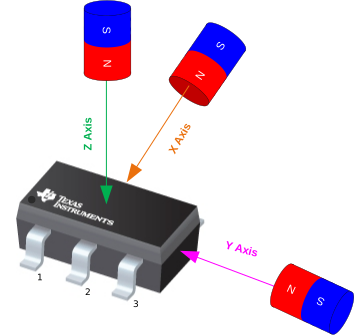 Figure 2-7 Field Direction
Definition
Figure 2-7 Field Direction
Definition